
By Sara Sparling —
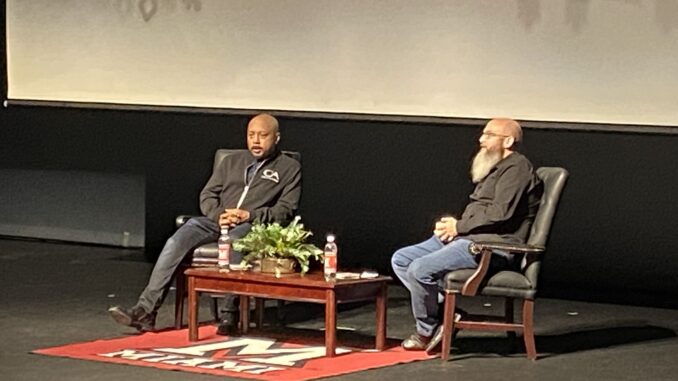
Recently, Miami Hamilton had the pleasure of welcoming Daymond John—CEO, author, businessman, and TV personality from the hit show “Shark Tank.” The interview with John was hosted in a “fireside chat” setting with special guest interviewer Brad Baker–a previous contestant on Shark Tank from Hamilton, Ohio. This event was hosted by Dr. Matthew Smith and the office of Public Programming.
After a warm welcome from Baker, John took the stage and gave a brief background concerning how his brand was established. It didn’t start out easily for him, and there were numerous bumps in the road. His mother worked extremely hard for John to be successful, and he didn’t want to see her have to stress and struggle, so he began working when he was ten. He came up with his brand FUBU and started out with only ten t-shirts. At the time, hip-hop was becoming popular, and he would ask artists to wear his shirts in music videos, which began leading to orders from the public.
Throughout John and Baker’s conversation, they focused on Shark Tank and aspects of the show viewers may not know about. A pitch shown on TV can be only a couple minutes because it is heavily edited from about an hour of footage. There are obvious parts of someone’s pitch that can’t be shown on television, such as foul behavior, so they must be cut out. Investors on the show also don’t know anything about those doing the pitching, or the products they’re bringing. It’s a completely blind experience for the pitcher, as well as the investors. Before someone can be a contestant on the show or granted any proceeds, they must complete extensive background checks to ensure, as best as possible, that they won’t be irresponsible with any potential winnings.
John then talked about pitching ideas to potential investors and aspects inside a business that are key to success. He noted that before pitching ideas to investors, one should do everything that is possible without money first–then, pitch investors. It’s also important to know exactly how much money is needed and what it’ll be used for. He shared, for example, that it’s unrealistic to go to a company and say you need four million dollars for a commercial; there’s no possible way all the money given will be going towards that. If you share exactly what is needed, companies will be more inclined to contribute.
Another important key to success is a strong business partner. It’s important to look for someone who’s a problem-solver, has an emotional and intellectual connection with others, can communicate well, and can think outside of the box–someone who, if they get knocked down, they get right back up.
Baker asked John what the most important internal business concepts are. John said that understanding what the business market is looking for is important, as is getting to know customers and what they’re interested in. It’s also important to leverage one’s opportunities and tools–such as AI, and scalability– and to understand when to keep a business small, and when to grow appropriately over time. John went back to when he started out with ten t-shirts: Start out with ten shirts, then get twelve shirts, then get fifteen shirts and two hats, and master that process. Gradually expand over time, all the while effectively articulating and developing a strong understanding of a business and consumers. This is better than diving head first into a business and not being successful.
John also discussed the changes in business that occurred during and after the COVID-19 pandemic, as well as what he learned from it. He is still seeing traces of the pandemic as businesses continue to struggle and recover from it. He noted that individuals will go to extreme measures for money, and it’s sad and scary at the same time. But, he also sees people making ends meet with what they have. These challenges will always be here, but it’s how we approach them that makes a difference. This difficult time in our collective history did create some great ideas, and brought out the best in a lot of individuals. “It [also] showed us that we’re all human,” John shared.
Baker’s final remark to John was about risk within business. John said entrepreneurs typically take the biggest risks out of any group. It’s important to take risks because that’s how pivoting from what someone has, to what they will have in the future, is possible.
Dr. Smith then took some time to ask John questions the audience had sent in earlier that week. For example, John was asked what advice he would give to incoming freshmen who are undecided on a path. John said it’s important to expand one’s circle and network, and to take advantage of every opportunity that is presented.

Through John’s advice and inspirational words, he proved that anyone with a drive and passion for something they love can easily turn it into something bigger and better—and possibly profitable. Most entrepreneurs don’t work for the money; they work because they’re passionate about something. So,if someone has the drive, they should use it. If someone fails at a business venture, it’s because they were in business solely for profit, or because they never wanted to put in effort and instead wanted instant success. John said these are the biggest mistakes he sees young, aspiring entrepreneurs making. He also stressed the importance of self-defined success: It’s important to follow what success means to each person individually, not what their parents say, and not what someone on social media says it means.
Finally, John gave a warm thank you to Dr. Smith and the Public Programming Committee, as well as everyone who came out to support him and the professors at Miami University for shaping the future professionals of the world. He wants everyone to remember that every room they walk into, they deserve to be there and be present.