
By Paige Auxier —
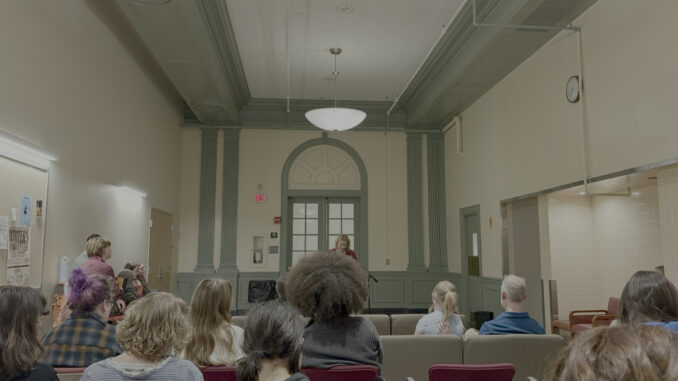
Recently, the 35th annual Writer’s Harvest fundraiser was hosted in Harris Hall on Miami University’s Oxford campus, as well as online via Zoom, by the Department of English, the Creative Writing Program, and the Western Center for Social Impact and Innovation. During the event, original art pieces donated and created by past and present Miami students were auctioned off, and four writers—three current Creative Writing MFA students: Will Danzi, Brooke Westgate, and Savannah Perry; and one university alum: Laura Gaddis—read their original pieces in poetry, prose, and creative nonfiction.
Professor Jody Bates MC’d the event and preceded the readings with a short introduction of what the night would entail, as well as a description of the event’s history. According to Bates, the Writer’s Harvest fundraiser originated in the 1990s through the non-profit organization Share Our Strength, which aims to assist children and families facing battles with hunger. Reading events were held all throughout the country through this organization for the remainder of the decade, but ceased upon its closure. However, Miami faculty opted to continue the tradition in the Oxford area and have, for the past thirty-five years, hosted the event annually each November in concert with the season’s spirit of giving.
In his introductory statement, Bates also made sure to note that the proceeds from the aforementioned art auction are to be donated to TOPSS, a local food pantry that provides both food and services for families within the local community.
The first reader, Will Danzi, shared a handful of original poems composed of short stanzas conveying images of mundane objects and circumstances, which he chose to recite in a level tone of voice. In combination, these factors all served to make his work feel more raw and honest, given that it was so blunt in its content and delivery. Upon listening to his work, one got the sense that it would only grow richer with repeated analysis, through which the audience could further uncover the deep meanings and emotions buried within his seemingly simplistic and vaguely correlated words and phrases.
The next performer, Savannah Perry, shared two pieces—one in creative nonfiction and the other in prose poetry—centered on her lived experiences as a resident of an underserved Appalachian community, in which food, opportunities, and resources were scarce. Her words painted for the audience a clear image of the scenes and emotions she was describing. It was also evident through the content of her writing that her work was incredibly personal. Audience members noted the emotional manner in which she spoke and the occasional wavers in her voice, as well as look in her eyes showing evidence of tears. All of this made her presentation all the more powerful to behold. Through speaking on her lived experiences in her writing, she effectively shed light on issues faced by her community, like food scarcity and lack of equal opportunity, which, in turn showcased the power of words in contributing to social justice and change.
The last of the student readers, Brooke Westgate, shared her works of poetry, which given their focus on experiences inherent to the human condition—such as being abandoned, suffering heartache, and dealing with the end of a relationship—were pieces that most members of the audience could relate to and connect with in some capacity. Also, her use of figurative language and descriptive imagery allowed the audience to forge a greater connection to her writing by so clearly articulating her thoughts and experiences.
The next speaker, and the night’s featured act, Laura Gaddis, closed the event with the reading of two excerpts from her recently published memoir Mosaic. The first of the essays she shared centered on her grappling with the realities of her experience with miscarriage, while the second delved into the experience of learning her prematurely born daughter would live to see a normal life, which was slightly bittersweet, since the infant next to her daughter in the neonatal intensive care unit was suffering from the same chromosomal abnormality that had plagued the child she miscarried; consquently, she knew this child would likely not see life outside the walls of the hospital.
Through these narratives, she touched on themes of grief, hope, and suffering, highlighting in particular how universal each is to the human experience. One of the most touching elements of her performance, though, occurred after it concluded, when her daughter, upon watching her mother wrap up her reading, presented her with a tiny thumbs up and a tight embrace to express both her pride and admiration.
Between each of the readings, Billy Simms, coordinator of the Western Center for Social Impact and Innovation, went to the podium and displayed the art pieces up for auction, and once all had presentations had ended, came up once more to announce the winners. After this, the crowd dispersed throughout the room, and lively chatter between faculty, students, and local literary enthusiasts ensued. At this point, too, several opted to indulge in the courteously provided eggnog, crackers, desserts, and pastries.
This event offers Miami students a valuable opportunity to show off their creative works, both for the purpose of earning well-deserved peer and professional recognition, but also for the sake of generosity. So, it can only be hoped that the event will persist for several years to come.