
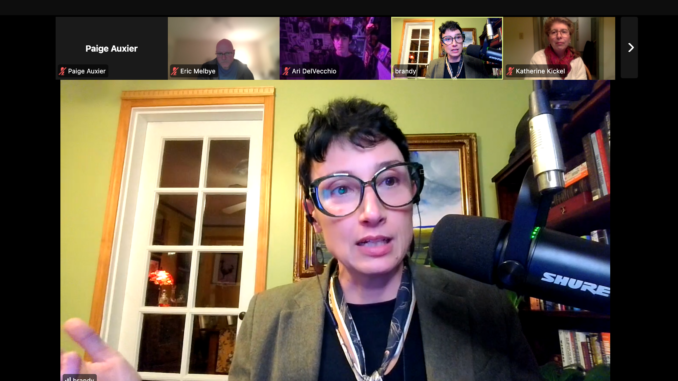
By Paige Auxier—
On Thursday evening, author Dr. Brandy Schillace spoke before a virtual audience as part of the Language, Literature, and Writing department’s fall conversations event. In their presentation, they touched on their most recent novel, The Dead Come to Stay, the second part of their fiction series centered on an autistic female detective.
Dr. Schillace also spent the vast majority of the call outlining the long road that led them to becoming a published author, specifically of fiction, which was a feat they’d long regarded as unattainable, given the complex nature of today’s publishing industry and the many doubtful comments they’d received from naysayers who found their desire to pursue a career in writing entirely unrealistic. They also graciously made sure to delineate a chunk of time for audience inquiry at the end of the event, and regularly paused their speech to answer questions as they appeared in the chat of the Zoom call.
As a professional, Shillace can be characterized as a “jack of all trades,” which, they noted, is a quality all writers are now being pushed to embrace, given the vastness of today’s literary and media landscapes. Presently, they work as a medical historian, a literary critic, a writer of fiction and nonfiction books, a freelance journalist, and a television host. Prior to this, though, they’ve worked as an editor of two academic journals, an office manager and CFO assistant at a private equity firm, a college professor across several disciplines, a museum curator, a painter of both portraits and murals, a grant writer, a public speaker, and a blog writer. Through sharing their personal professional history, Schillace demonstrated to the audience that if one doggedly pursues the things they desire, they will eventually end up exactly where they’re meant to be.
Schillace always envisioned themself as an artist or writer, but after graduating from college, felt pressured to work in a more lucrative field. However, after working in finance for several years, they realized that alongside their monetary gain came a sense of spiritual drainage from being creatively unstimulated. So, with hopes of entering a profession that better engaged their personal passions, they returned to school to earn their doctorate and, after graduating, entered academia. They learned, though, after working for several years as a professor, that teaching wasn’t for them either, and so determined to switch careers once more and pursue writing professionally, which was a tedious yet ultimately successful venture.
Dr. Schillace spoke in depth about the realities of today’s publishing industry. Individual writers, given the influx in the number of books being published per year alongside the advent of generative AI, now have more voices to compete against and, in turn, must be increasingly savvy in order to have their books published. Schillace also noted that to navigate and succeed in today’s modern literary landscape, one must have a strong sense of self and their skills, as well as an understanding of what’s best for them.
Schillace is open about having autism, too, which they didn’t receive a proper diagnosis of until adulthood. Throughout their presentation, Schillace noted several aspects of their condition that have influenced and even accentuated their work as a writer, framing it not as something negative, but rather a mere part of who they are as a person. For example, as a result of autism, they have always had trouble reading others, and have, in turn, developed strong skills in translating people, which they’ve implemented in their creation of fictional characters in their novels. They also noted that they tend to center their work on their special interests, which are a symptom of their autism.
Overall, their message seemed aimed at uplifting their audience members, several of whom were young, aspiring authors seeking to benefit from Schillace’s insight. They shared that throughout their life, they had been told by others not to do several things, but ultimately found that one is more apt to find contentment if they ignore those suggestions and instead do what feels natural and brings them joy. They also made a point of noting how important it is, in today’s society, to use and recognize the power of writing and discourse. Through their work, they were able to directly manifest positive change in the world around them and urged their audience to do the same by channeling their skills and passions towards the task of writing their way into a more ideal future.