
By Paige Auxier —

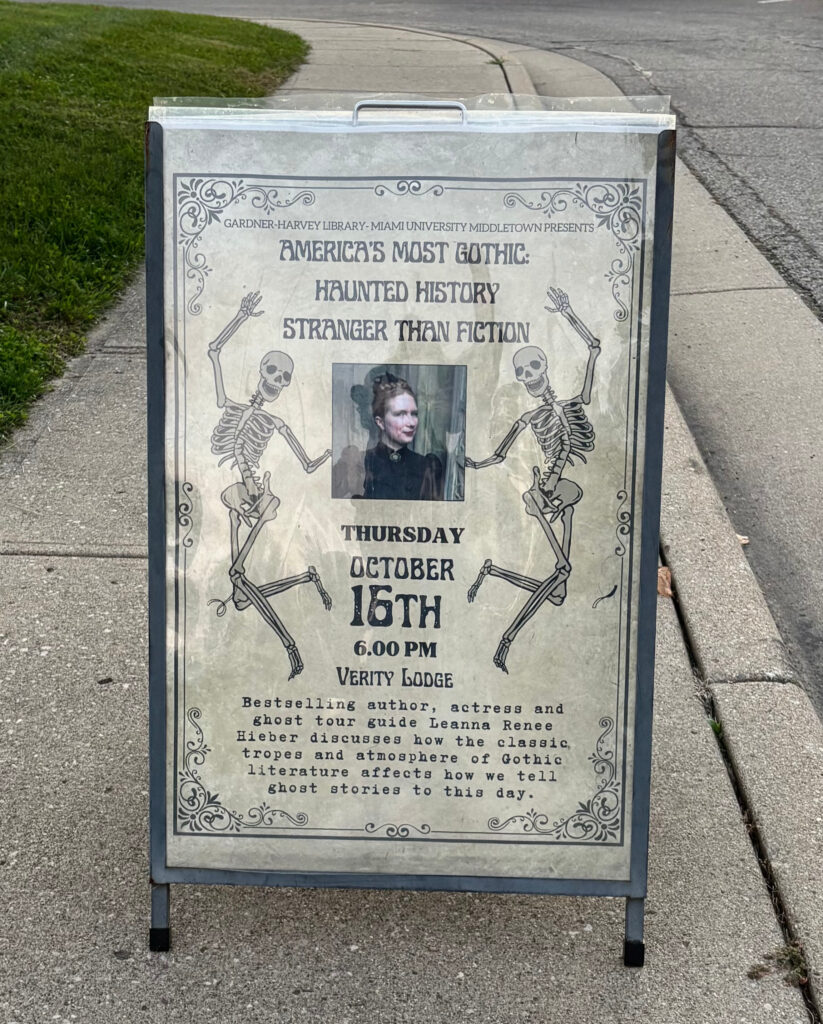
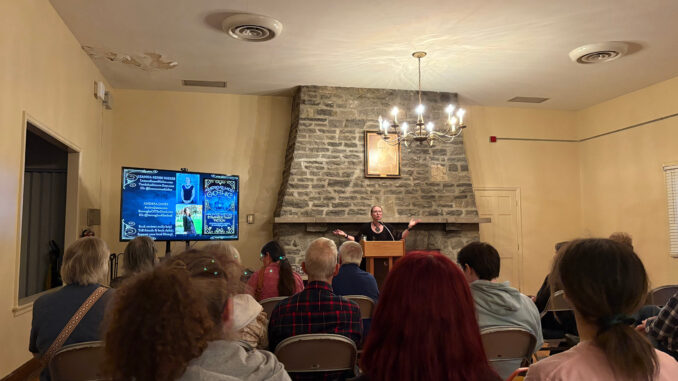
This past Thursday, at 6 P.M., an eclectic group of young and old attendees gathered at Verity Lodge on Miami University’s Middletown campus for an hour of spooky storytelling.
At 6:03 P.M., a hush fell about the chattering crowd as John Burke, Principal Librarian at the Gardner-Harvey Library on Miami’s Regional campus in Middletown, took his place at the podium in the front of the room to introduce the night’s speaker. He informed the audience that in their presence was Leanna Renee Hieber, an actress, playwright, audiobook narrator, ghost tour guide in New York, and award-winning author of both fiction and nonfiction books. The topic of her discussion that evening was her newest published work of nonfiction, America’s Most Gothic: Haunted History Stranger Than Fiction, which she wrote alongside co-author Andrea Janes.
Upon introduction, Hieber approached the podium to fill Burke’s spot, dressed as though she were a modern-day witch in all black attire that consisted of a flowy cloak-like cover-up, a simple black dress, a corset adorned with silver accents, and a short-length necklace bearing a large pendant. After taking her place, she looked out at the crowd through her round, wide-rimmed glasses, wearing an expression of earnest regard and excitement.
Her discussion began with a brief introduction to the Gothic genre. She first described its origins, which trace back to the publication of the novel The Castle of Otranto by Horace Walpole in 1764. Then, she outlined to the audience what she regards as the defining elements of Gothic fiction. Such elements were identified as the following: the inclusion of a setting that acts as an entity in and of itself, like a haunted house; a main focus on the psychological state of the characters; and a sense of dread acting as the engine of the plot.
She also noted that a unique affordance granted to the genre by the above-mentioned elements is that it tends to involve readers by placing them in a position in which they are forced to judge the characters’ often irrational thoughts and actions for themselves. Works of Gothic fiction also tend to have complex and adaptable plots, as well as the capacity to swing on a pendulum between the terrifying and beautiful. It’s this complexity that makes the genre so intoxicating to her as both a reader and writer.
After properly outlining the specifics of Gothic fiction, she went on to discuss her most recent book, America’s Most Gothic: Haunted History Stranger Than Fiction. In this work, she and her co-author Andrea Janes examine ghost lore from the perspective of Gothic fiction. Inspiration for this premise was born from a mutual realization they had while working as ghost tour guides in New York. Both had, in time, begun to recognize that the ghost lore they encountered tended to mirror the fictional tropes commonly found in Gothic fiction, to a point that almost seemed cyclical. So, to examine this trend further, they conducted research and wrote a book about it. She then outlined in her presentation which specific tropes, or themes, they chose to examine within the text; these tropes included, but weren’t limited to, stories centered on haunted houses, hidden chambers, and mysterious omens.
After presenting an overview of her novel’s origins and structure, she shifted her focus towards a particular chapter in the book that examines the ghostly lore of Helen Peabody, Western Female Seminary’s first principal, who is said to now haunt the resident hall that bears her namesake on Miami’s main campus. As an alumna of the university, Hieber is well acquainted with the legend and sought to include it within her work. To do so, she conducted a significant amount of research on Peabody, and a large part of it, she noted, was done through the Havighurst Special Collections at King Library on Miami’s main campus.
Hieber noted to the audience, upon starting her discussion of Helen Peabody’s life, that both she and Janes tend to develop a personal connection towards the real individuals whose stories they share and examine. This fact was, however, evident through the caring manner in which she spoke of Peabody.
Hieber stressed that she aims to avoid describing the lives of real people involved in ghost lore in a two-dimensional manner that limits their existence to the confines of predefined themes or motifs. In the case of Helen Peabody, her story may at first seem to be that of a domineering matron with a prejudiced sort of hatred towards men; however, she argues that there is much more to her history than meets the eye.
Hieber informed the audience that, based on her research, it seemed that Peabody’s controlling attitude stemmed from her care for her students. She believed in each of them, and her subjecting them to strict rules was an attempt to instill in them that same belief in themselves. She recognized that as women existing in that era, they would inevitably be forced to bend to the will of others, and she hoped that by being so strict, she could create an environment that would grant them autonomy and serve as a space where they were permitted to be alone with themselves and their studies. This point is where her supposed hatred of men comes into question. Hieber argued that her desire to keep men from her students was more an attempt to bar them from serving as a distraction to the young girls.
After wrapping up her discussion of Helen Peabody’s lived experiences, she delved into the alleged details of her afterlife. In 1974, Western College merged with Miami, which rendered Peabody Hall a co-ed space. Given her historically fierce desire to keep men from her students, this change was one that Peabody would’ve undoubtedly hated. So, legend has it, she now haunts the men who abide within the hall.
In her discussion, Hieber outlined a series of alleged tales regarding the activities of Peabody’s ghost. The most notable of these occurred in the nineties and was directed towards two male roommates. After hearing the stories of her ghost, the boys took it upon themselves to test the validity of the lore by taunting Peabody’s portrait in the building. After doing so, they supposedly began to experience paranormal activity: They heard knocking from inside their wooden wardrobe, their lamp flickered and crashed on the desk, and the red message light of their phone glowed ominously without the prompt of a ring, and continued to shine even after they’d unplugged it.
Following these frightening occurrences, they contacted their resident assistant and shamefully explained their predicament. Then, after scolding them for their stupidity, this assistant called the telecommunications desk to inquire whether any calls had been made to the boys’ room. The worker at the desk informed them that a whopping 200 calls had been made, and the recording of each played back their earlier conversation in front of the portrait.
One of the boys also entered a sort of drugged and delirious state, and it was impossible for others to rouse him from unconsciousness for a time. Then, upon finally waking up, he explained that he’d been held down by a woman in his sleep who prevented him from rising out of his slumber.
Afterwards, Hieber was asked where her interest in ghost lore and gothic fiction originated, and she provided a passionate response. She explained that it started in her youth, when, at eight years of age, she entered a Barnes & Noble and gravitated immediately towards the works of Edgar Allen Poe, the quintessential American Gothic author. From that point forward, her interest bloomed. She also noted that one of her favorite childhood pastimes was scaring her friends in Girl Scouts with ghost stories around the campfire. She stressed to the audience that ghost stories aren’t always scary, either, and that her interest in the paranormal also originated from a positive experience she had at six years old with the ghost of her great-grandmother at the time of her passing. She was herself incredibly ill at the time, and amazingly, her high fever broke at the exact moment her great-grandmother passed on. Through this experience, she realized ghost lore is something that can be scary and fun, yet also positive and endearing. Ghosts are, after all, the remains of people who were once real, which is why in her work, she aims to avoid telling their stories in a two-dimensional manner, that frames them as no more than the source of a jumpscare. Instead, she strives to describe them with a broader scope of who they were and are.
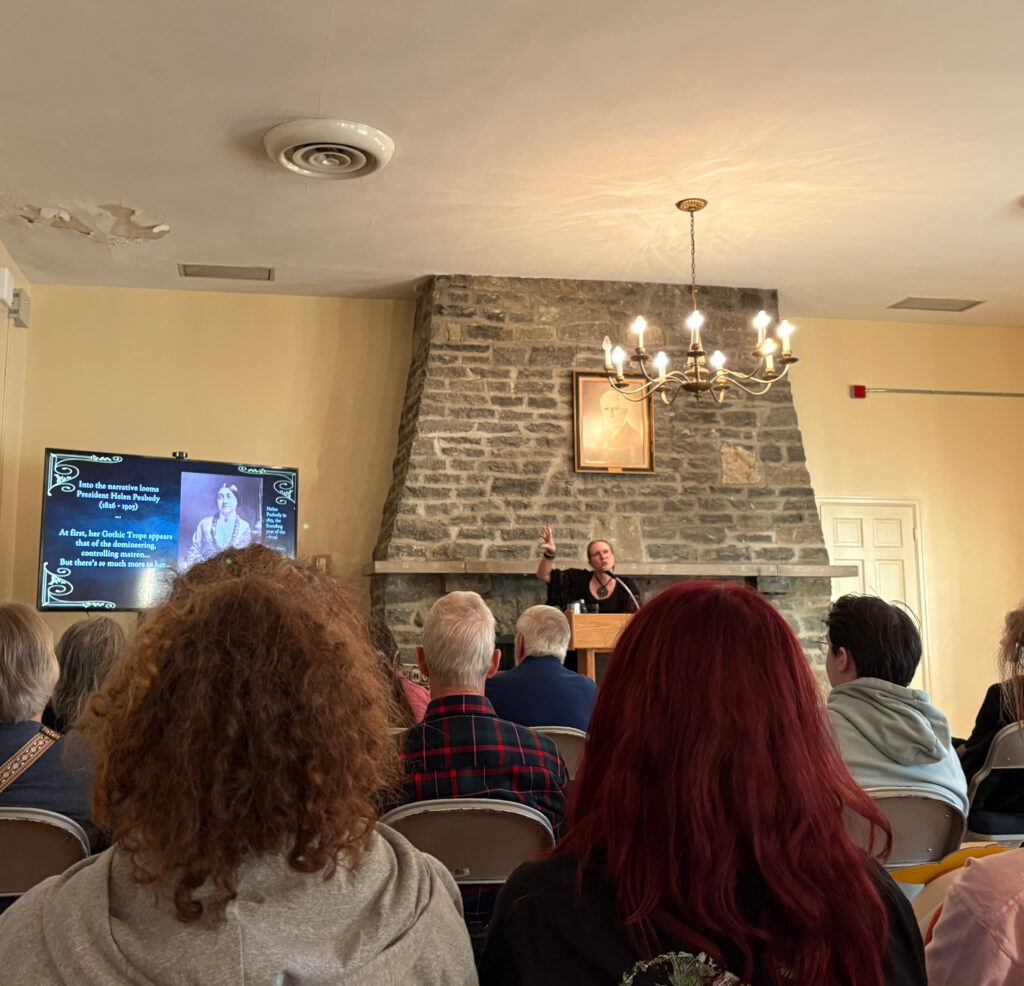
Hieber spoke of her work with such evident passion. All elements of her demeanor, from the gestures she made to the excited inflection of her voice, indicated that she truly cared about the topics she was discussing. Such enthusiasm tends to be contagious, and in this case may have been powerful enough to persuade even those typically adverse to Gothic fiction and ghost stories to indulge in the genre, or at the very least, appreciate its virtues.
So, for anyone who enjoys such works or is open to the idea of exploring them further through the unique lens of nonfiction narratives, her book America’s Most Gothic: Haunted History Stranger Than Fiction may be a good choice, especially now with Halloween so rapidly approaching.