
By Paige Auxier —
This past Tuesday afternoon, a group of community members with a shared interest in geology met via Zoom for an informative lecture on the formation of the Great Lakes, headed by Miami professor Dr. Tammie Gerke, as part of her three-part talk series this semester.
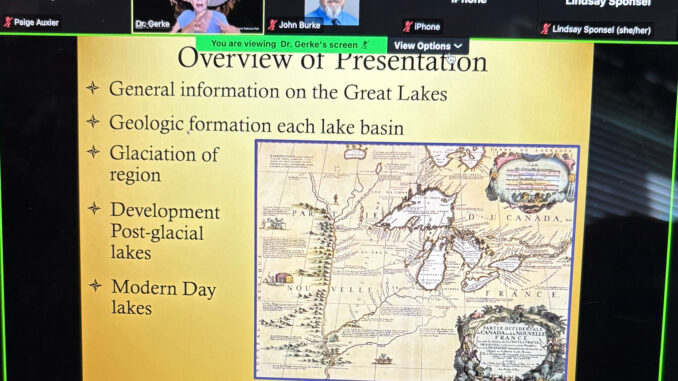
Her presentation of the Great Lakes’ history was broken up into four sections and effectively covered a wide range of topics. These included a portion dedicated to providing general information about the Great Lakes, a description of the geologic formation of each lake basin, details of the glaciation of the region, and an explanation of how post-glacial lakes developed.
As part of the initial portion of her presentation, she listed a series of fun facts to hook the audience’s attention. One such fact was that 85% of North America’s and 20% of the world’s freshwater exists in the Great Lakes. The bulk of this section, however, was dedicated to her detailing specific characteristics of each lake, which included, in particular, their individual depths and retention times: the amount of time it takes for new lake water to replace the old.
After effectively providing an overview of the Great Lakes as they exist today, she took a step back in their history to outline the geologic formation of each lake’s basin–the depressed part of land that holds their water–and the ancient Laurentian River System, at sites of failed rift zones and volcanic activity.
She then moved forward to describe the effects of continental glaciation. She articulated to the audience that the movement of glaciers contributed to the formation of the Great Lakes by carving out the lake’s basins and sinking the land on which they traversed with the pressure of their staggering weight, which severely altered the Laurentian River System that had existed long before glaciation, and formed today’s Great Lakes.
Her detailed approach to presenting information was comprehensible even for individuals with a novice understanding of geology. She effectively struck a balance between being informative for all and sensitive to those with limited knowledge of the discipline. Gerke was also strategic in her selection of visuals and diagrams to help the audience make sense of the facts she was sharing, and paused regularly to take questions. She had an enthusiasm about her as well, and spoke with great eloquence on the topic, which showcased both her personal passion for the subject and her wealth of knowledge in regards to it.
Despite the limitations of the digital platform, the meeting’s environment still managed to feel collaborative. Dr. Gerke asked throughout the whole of her presentation for suggestions on what topics to discuss in future lectures and consistently paused to encourage participant inquiry. She also gave the option, for students weary of speaking out in the call, to type out their questions in the chat, and tasked one audience member whom she seemed well acquainted with to monitor it. Prof. Gerke made sure to save time at the end of her presentation for discussion as well.
There was a notable sense of community within the group. The host seemed familiar with the bulk of the attendees and strongly encouraged all to participate in the discussion. She even permitted guests to speak on topics that didn’t pertain to plate tectonics, such as upcoming fundraisers and community events.
So, for anyone with an existing or blossoming interest in geology who is seeking to spend an afternoon learning more from an expert on the topic from the comfort of their own home, amongst a group of students and community members with a shared interest in the discipline, consider attending the third and final part of this discussion series on November 18, 2025. At this discussion, Prof. Gerke will discuss Dan Egan’s book The Death and Life of the Great Lakes, which is, as she made sure to note, not required to be read by attendees prior to the meeting.