
By Maureen Wilson —
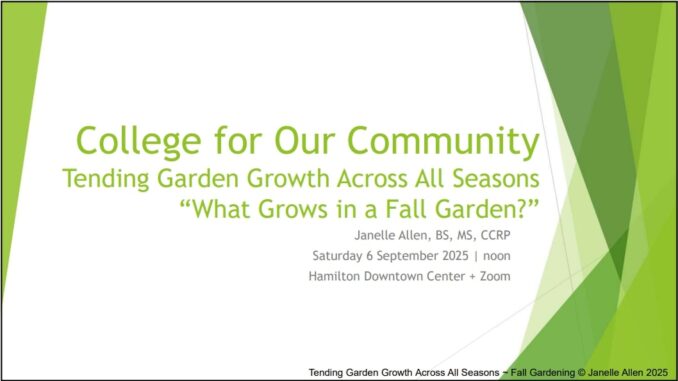
When it comes to gardening, fall may not be the first season to come to mind. But, it can be a pivotal time for growth and harvest under the right conditions. In the first “College for Our Community” installment for this semester, hosted on September 6th, Biological Sciences professor Janelle Allen introduced the potential opportunities growing a fall garden can create.
The first step is to contextualize where the garden is being grown. Both Middletown and Hamilton campuses land squarely in Southwestern Ohio, which falls underneath USDA hardiness Zones 5 and 6. Basically, these zones can sustain a variety of crops when planted ahead of time, before the frost date. But, these crops are seasonal too, primarily falling in-between warm and cool season crops. Warm season crops are cucumbers, tomatoes, zucchini, beans, and squash, to name a few. Cool season crops, on the other hand, are carrots, spinach, onions, and lettuce. Additionally, herbs and garlic fare well in Ohio’s weather.
When it comes to preparing for the fall season, it’s important to maintain and harvest the preexisting summer crops. This includes regularly weeding, watering, and monitoring for pests and diseases. Aerating and overseeding are also typically done in the fall or late summer, as the cooler lawn provides ideal conditions. While incorporating those into a routine, it’s good to start sowing cold-season crops throughout late August to September. Naturally, the process isn’t a tidy one. Composting, mulching, and tilling are all techniques used to improve not only soil health, but the general look of one’s garden.
Janelle Allen continued her presentation by discussing the many benefits of composting, a consistent theme in her goal to educate her audience about the many ways to reuse waste. Some of the pluses of composting include naturally promoting soil nutrients, lessening what goes into landfills, saving water, and boosting the community among other composters. Composting can be broken down into separating brown items (dry leaves and grasses, sawdust, hay) and green items (fresh leaves, grass clippings, coffee grounds, food scraps), and layering them from there. It can be done almost anywhere, making it convenient for anyone to begin. But if composting doesn’t fit your particular goals of gardening, Allen introduced a couple of different ways of preparing and eating harvested crops. Cooking methods such as sautéing, boiling, or blending into a smoothie for example, or processes like sun drying, are versatile for creating new dishes. Of course, simply eating the food raw or collecting them in cases of various berries and herbs are acceptable, too.
There are general rules for all seasons, not just fall, to keep in mind for gardening. Soil preparation and having the appropriate landscape are equally as important to planting the seasonal seeds. Test the quality of the soil via its pH level and invest in raised beds if necessary, and investigate the hardscaping elements of your outdoor space (patios/porches, paved walkways, driveways). It’s best to embrace the natural state of the land when gardening, while keeping in mind nearby water sources, where shade is located, and the wildlife in the area. Doing this promotes a healthy relationship with the soil you’re working with and can save money, as water and seeds aren’t being wasted during the process. Some issues are specific to certain seasons, like humidity in the summer and frost in the winter. Regarding humidity, water management is key, as well as picking more disease-resistant plant varieties. Frost is a bit more complicated, often requiring some mulching to insulate the crops, trimming back perennials, cleaning excess debris, and utilizing protective covers.
As the presentation came to an end, Janelle Allen took some questions from the audience. The first question was about her favorite way of using fall harvests. Allen began by saying that “it’s sort of an adventure you go down. You find what harvests you have in your fall garden and you see what’s in your fridge.” Stews and soups are an easy way to use dried herbs and vegetables for her. She continued: “Beets are interesting because I think you could put mint with them. You could put basil with them. I’ve never really put rosemary, but you could and they’re good.”
The second question pertained to specific frost dates for the Southwestern Ohio region. Allen first referred to the Farmer’s Almanac and the calculator they have on their site. She then highlighted the importance of keeping the frost date in mind when planting. “If you think about it, when we say that things have frosted or they’re frozen, the water is crystallized in there, right? So, if we can imagine the water that’s in the roots, the water that’s in the stem, that’s in the leaves, that will be freezing. So, if it’s not a hardy plant, it could kill it or it will die.” In short, planning and planting ahead is pivotal. The frost dates for Hamilton and Middletown are October 13th or 17th, depending on the specific zip code.
Be sure to catch Janelle Allen’s next presentation, “The Underground Academy Presents: Your Guide to Special Trees on the Middletown Campus,” on October 1st at 4 p.m.