By Tricia Cherry —
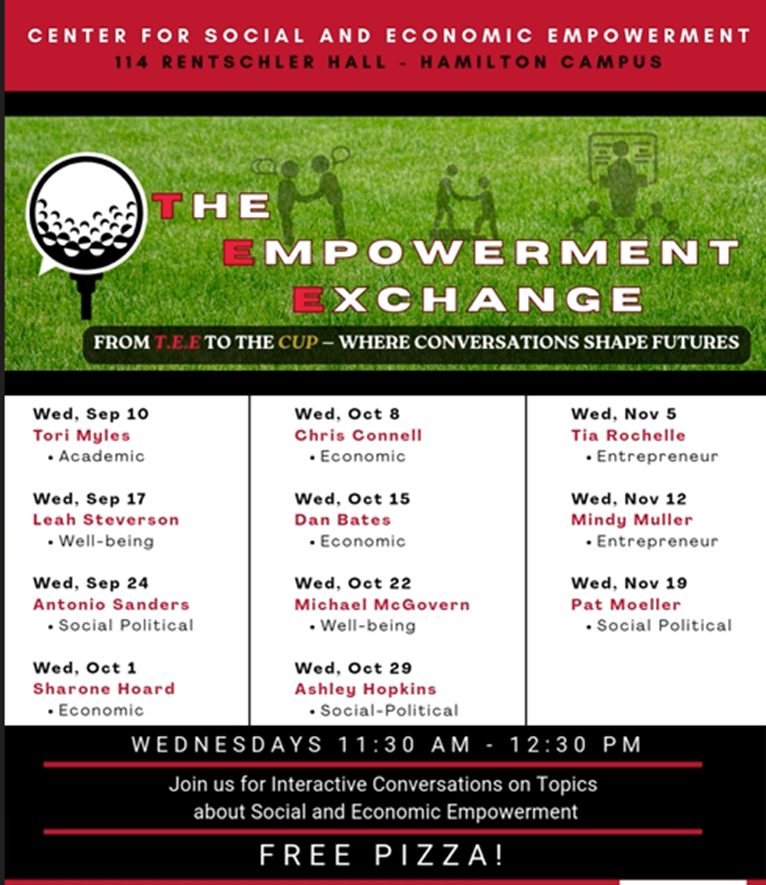
The Empowerment Exchange is a weekly meeting held in the Center for Social and Economic Empowerment in Rentschler Hall, on the Hamilton campus of Miami University, from 11:30 to 12:30 on Wednesdays.
The meeting was informal with a relaxed atmosphere. Free pizza is available to attendees of these sessions and the guests they are encouraged to bring.
Those in attendance started things off with what Dr. Hamilton called a “mindful minute,” which is a grounding exercise. One breathes in slowly for four seconds, holds their breath for four seconds, then lets it out slowly over four seconds. This is meant to center the self and become aware of one’s own breathing, which is shown to help in times of stress.
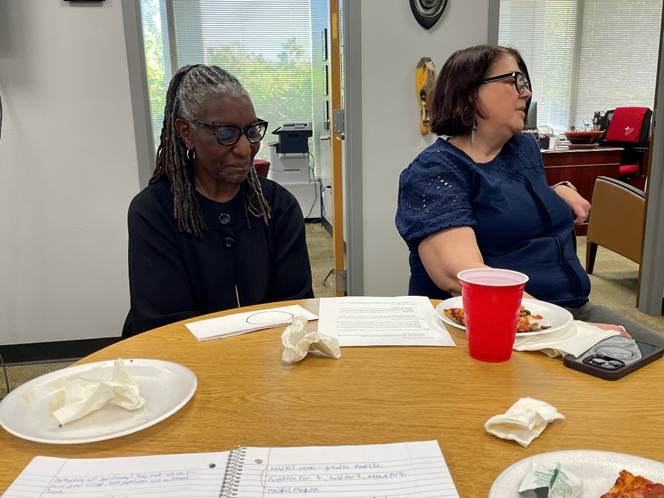
A topic of discussion at this session concerned the nature of balance. One attendee compared balance to a see-saw, while another invoked the Eastern concept of Yin and Yang—how seemingly opposite forces in fact need each other in order to exist in harmony.
Another bit of advice that was given was to realize that one can’t control everything and to accept that.
Stress reducers were next. Engaging in a hobby for thirty minutes, or until calm, was the first suggestion. Physical activity is especially useful to this end: taking walks, playing a sport, or even just kicking a ball around. However, many people also rest or take naps as a sort of ‘hard reset’ to their focus. Both of these things recenter the mind.
The issue of phones eventually came up and would take up the rest of the hour. According to Lori Parks, an article was written about students—both Miami-affiliated and those from other universities—who are reportedly looking for flip phones as an alternative to smart phones, which can be addictive in much the same way as gambling can: They provide short rushes of dopamine that get the user hooked, often with negative results, as the brain becomes more and more dependent on that rush.
Phones today are highly addictive, but their necessity is debatable. It’s not as simple as saying ‘phones are bad.’ On one hand, they are not strictly needed to survive; one does not need a phone the way they need food, water, or shelter. However, they are necessary in the way that cars, employment, and citizenship are—essential to today’s society because of its structure.
The session ended with another centering exercise. Studies show that a huge part of what makes humanity unique is the ability to express gratefulness. Without undue pressure or prompting, attendees listed whatever they were grateful for. Answers ranged from knowing one’s purpose in life and having the opportunity to follow that purpose, to simply having free pizza.
When asked about what inspired her to begin these meetings, Dr. Hamilton said, “Our students need tools outside of the class that will help them be successful. Our students are brilliant, have a lot to say and have valuable information.”