
By Maureen Wilson —
Using artificial intelligence to complete assignments is typically frowned upon, but what is its role in research? While concerns about academic integrity raise an important question regarding how we classify original content, in the initial steps of research, possible use of AI has its own pros and cons. In the second installment of Gardner-Harvey Library’s “Your AI Toolkit” series, John Burke explained the many ways students can ethically use AI in their research gathering and planning.
The presentation began with Mr. Burke acknowledging the normalization of AI in casual research, mostly through Google’s AI overview and assistant Gemini. “It’s the kind of thing that I think people don’t even notice they’re using at first,” Burke remarked. Given such easy access, most students don’t click through sources anymore, much to the detriment of smaller site owners who depend on the traffic and revenue. Additionally, these overviews may not even cite their own source and provide a broad amalgamation of information. Large language models (LLMs) are where that information is drawn from and are catered around different datasets. These models have varying degrees of quality, some containing outdated or unverified sources. This specialization can allow different AI tools to be better in some things and not others. With potential biases and inaccuracies in the mix, AI’s push to the top of search results could be unreliable at best, and disinformation at worst.
John Burke then transitioned to answering a pivotal question: Who owns the data? Generally, companies behind AI development don’t explicitly ask for permission from the original authors or publishers. Monetized work without compensation has become a hot button issue within the academic community, and although there has been talk of receiving royalties, the amount is uncertain and not sustainable for the output AI is creating, compared to human efforts.
Before diving into how to brainstorm with AI, Mr. Burke discussed a method of evaluating online information called SIFT. The acronym stands for “Stop, Investigate the Source, Find Trusted Coverage, Trace to the Original,” as originally defined by Mike Caulfield. In short, this method recommends users not take information at face-value, and question if its original context aligns with one’s own goals. Burke compared this framework to lateral reading, another fact-checking strategy that involves investigating unknown sites by consulting other sources on its credibility.
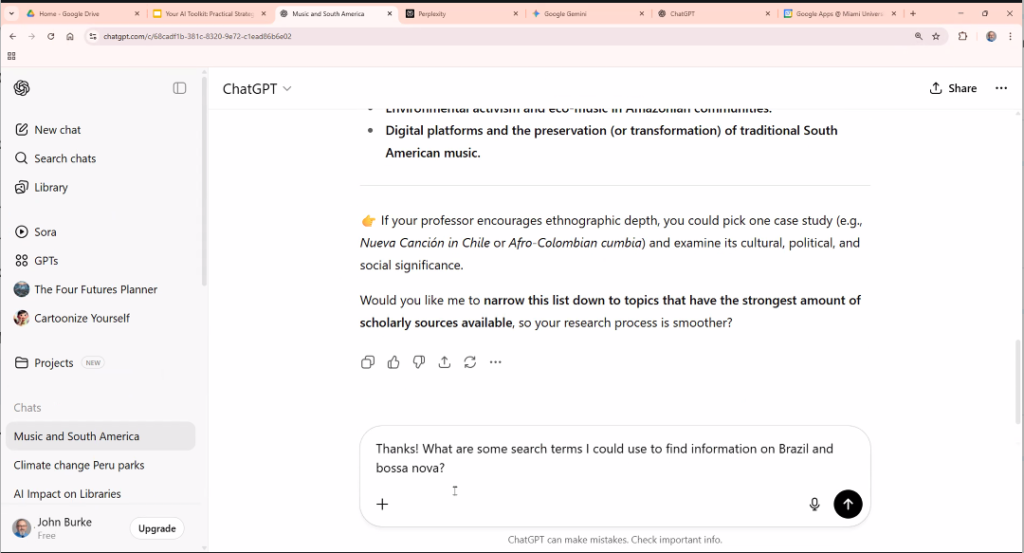
At this point of the presentation, John Burke demonstrated how to best utilize AI to plan and execute research. He started with ChatGPT and asked it to brainstorm specific topics and to provide optimized search queries he could use to find the best information.
He then used a different topic to explore with Perplexity, a popular AI research tool primarily used to find peer-reviewed sources.
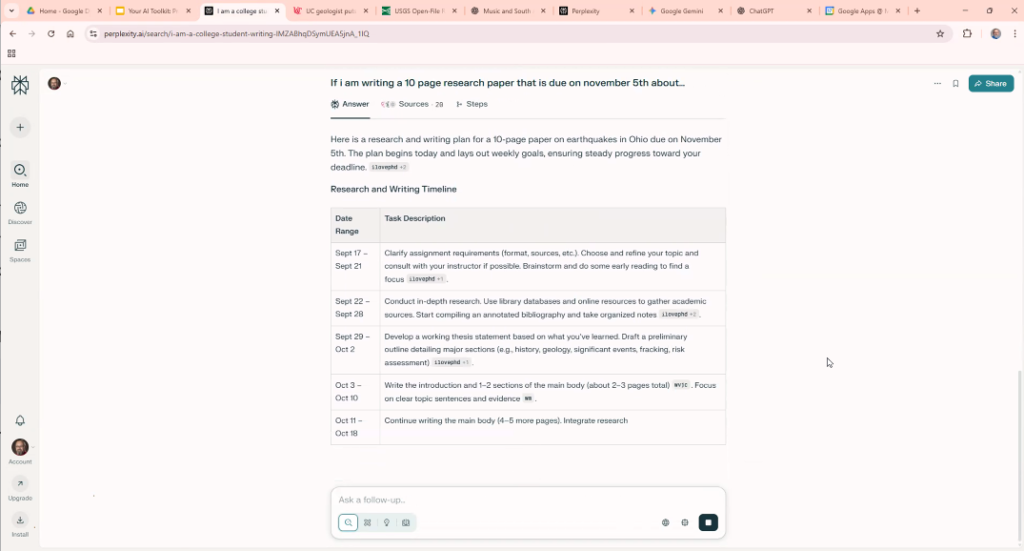
Burke discussed how asking for a detailed research plan could also aid someone’s thought process and relieve anxiety related to academic workloads. “Is this artificial? Yes. But it reminds me of a tool we used to use in libraries—a simple form you’d fill out with your topic and due date, and it would come back with a plan like this.” These plans that are provided usually cite their sources as well.
Searching efficiency can be expanded to using AI summaries of articles (or other types of information) in order to identify relevance. These tools are usually free and easy to use, typically only requiring an URL, direct text, or PDF upload to function. Some tools are explicitly built for the use of scholarly research, such as Semantic Scholar, Scite.ai, Elicit, Research Rabbit, Consensus, and LitMaps. Each of these tools have their unique strengths. For example, Scite.ai succeeds in providing empirical and quantitative studies, while ResearchRabbit is better equipped to visualize citation networks. Burke concluded, “Most of these tools do pretty much the same thing … but they really expand what AI can do for scholarly work.” Nonetheless, everything boils down to what the faculty and institutional expectations are regarding AI usage. It’s important to pay attention to the syllabus and what policies instructors expect their students to adhere to, as there isn’t a formal university-wide policy for Miami yet.
Burke finished the presentation by discussing the ethics of using AI. He advised against partaking in plagiarism, especially since the sources for AI can be difficult to identify and cite. If you do use it, disclose it as a brainstorming or researching tool to instructors. Burke also pointed out the rise of “AI slop,” where low-quality content is getting churned out at high rates, and in excessive amounts. By applying critical thinking skills, users can properly identify what’s original or not. Lastly, there’s a significant concern regarding the environmental effects and infringements of privacy that AI presents, but using AI models in moderation can minimize the impact of both of those issues.
The next event at Gardner-Library is Dr. Tammie Gerke’s lecture discussing how tectonic plates shift over geologic time, as part of her “National Park Talk” series. Don’t miss it!