
By Noah Neeley —
Student orientation and registration, more popularly known as “SOAR,” is a process that nearly all Miami Regionals students have been through, but what exactly goes into it? Let’s take a deep dive into this comprehensive and near-universal experience for new Miami Regionals students.
What is SOAR?
To understand what goes into SOAR, understanding what it covers is important. It is handled online, but most new students attend the in-person SOAR on campus. During the on-campus SOAR, new students are introduced to the Student Activities and Orientation staff and are taken on a tour of the campus over the span of three hours.
While touring the campus, students have the opportunity to visit booths that represent various student organizations and important resources on campus, such as the library and TRIO, among others. They also, and perhaps most importantly, meet with their academic advisor for a 30-minute session to schedule their classes for their first semester, as well as discuss long- and short-term goals.
Along with advising, students are introduced to the different buildings around campus during SOAR, and the important resources they should know about. SOAR familiarizes students with numerous offices and departments on campus: the Tutoring and Learning Center (TLC), the Center for Student Empowerment and Engagement, the ROSA room, Rentschler Library, Career Services, and others. With only three hours to complete the tour and several important presentations, a great deal of work has to be done in preparation, to ensure that orientation runs smoothly.
Who Runs SOAR?
There are numerous individuals involved in making sure that SOAR runs properly, but the lead organizer for this event is Julia Pond, the Regional Director of New Student Programs and Engagement. After inheriting the program last year, she has taken the reins and made adjustments to the program so that it runs as efficiently as possible, while simultaneously getting students the information they need to succeed both academically and socially on campus.
Pond can’t do everything by herself, of course, so a group of students are hired to work as Regional Orientation Leaders. Among their numerous duties, they conduct new student tours and generally introduce students to the campus and its resources and facilities. When hiring for these positions, Pond searches for students with a wide range of interests and personality types. “They all need to have a commonality … they are leaders, and they love this place, [and] they want to share the positive parts of this institution,” she says. Many of the students chosen to be orientation leaders are already deeply involved in Miami Hamilton’s student activities, whether it be student employees in campus spaces such as the TLC, or leaders of organizations like Regional Student Government.
Along with Mrs. Pond, the other staff of the Student Activities and Orientation department work to plan and coordinate SOAR. Derek Rice, the Regional Coordinator for Student Activities, runs the student life section of SOAR, introducing students to the different clubs and organizations. Andy Richard, Regional Administrative Assistant, also works closely with the Regional Orientation Leaders to keep the operation running on time and with as few issues as possible.
What has Changed?
SOAR is a program that is often in flux. Changes and improvements are necessary, not only to keep up with an ever-evolving institution, but also to improve the experience for students. With Pond now in charge of the SOAR program, there have been overhauls that followed feedback from the summer of 2024. Namely, they are aiming for a more natural tour with information given to students gradually, rather than all at once.
To achieve this, SOAR has been changed this year to remove the formal tour portion of orientation, which used to take thirty minutes of walking around campus and explaining different areas or departments on campus. Instead, groups now have extra time to reach each of their destinations so that orientation leaders can naturally introduce students to different areas of the campus as they go. This organic approach disperses information at a more digestible pace while also introducing each building as they use the services within them.
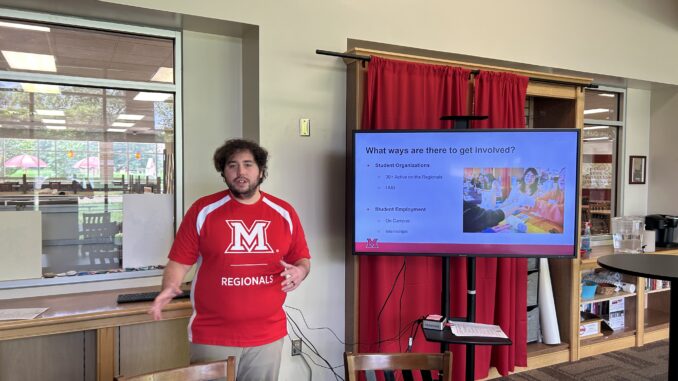
Over the past few years, Rice has been steadily improving his presentation for SOAR. Coming into his role shortly after COVID, when student organization participation was at an all-time low, Rice had his work cut out for him when it came to rebuilding student activities at Miami Regionals. “There were only five or six organizations on campus at that time,” he said, “so I needed to get new students engaged in joining clubs and starting their own organizations.”
Initially, Rice was covering much more than just organizations and clubs during his section of the orientation tour. He had portions of the tour devoted to student resources such as the library and TLC, but he found that it made it more difficult to get students engaged. Over the years, he’s focused his presentation on getting students interested in campus activities and clubs, as well as making students aware of their ability to organize events and create organizations.
What are the Challenges?
While SOAR is clearly well-planned and executed, some of the challenges that arise during orientation are unavoidable. When introducing dozens of students to a school every day over the span of only three hours, some struggles arise.
The most common challenge, and the one that is just about unsolvable, is that of cutting through the awkwardness of orientation. Because it is many students’ first introduction to the university, they are often—and understandably—nervous and quiet, which challenges the orientation leaders in some respects. SOAR is designed with this in mind, introducing students through icebreaker activities and conversations with orientation leaders. While these activities help to alleviate some potential awkwardness, it is often up to individual orientation leaders to get new students engaged by adapting to the attitude of the group and laughing about the mishaps that may occur.
Adaptability is the most important skill to have as a Regional Orientation Leader, according to Amaunie Wilson, a Regional Orientation Leader and RSG Vice President. “You have to read the room and know when to lean into the awkwardness.” Different groups have different attitudes, and questions from students can be unpredictable. “The other day we had a student ask if they could climb the trees on campus. There’s always a question we’ve never heard being asked,” Wilson said.
SOAR is also a race against the clock. Each orientation lasts only three hours, much of which is taken up by presentations and advising. As a result, finding a balance between explaining all of the necessary information, answering questions, sharing personal anecdotes and interests, and making it to the next destination on time, is highly important. Fitting all of this into the allotted time without overwhelming new students is a delicate balancing act that orientation leaders work to perfect.
What is the Outcome
The importance of SOAR is getting students the resources they need to be successful at Miami. Scheduling classes and planning for their major is a daunting task for new students, so the 30-minute advising session is critical. Additionally, SOAR familiarizes students with the campus itself, giving them an idea of where everything is and what each building and department specializes in. On top of familiarity with the campus and academic planning, SOAR breaks down the barrier for entry to student activities, giving incoming students the tools to join various communities at Miami Regionals.
The students aren’t the only ones getting value out of SOAR. Organizations and offices are given the opportunity to interact with new students that might be interested in their activities or facilities. RSG President Antonio Sanders stated, “In the first month of SOAR, about thirty people signed up, expressing interest in student government,” a level of interest he wouldn’t normally expect to see from other events with more established students. This same sentiment is shared by areas or programs such as TRIO, or Rentschler Library, which both find that it’s much easier to get new students to speak with them during SOAR about the resources they have available to them at Miami.
SOAR, and orientation as a whole, is an immensely important part of preparing students not only for the academic side of attending Miami Regionals, but the social side as well. With around 800 students participating each semester, SOAR sets up a significant number of incoming students for success—ones who might otherwise experience real struggles, or feel disconnected from campus. Orientation is always evolving to better serve students’ needs, but it will continue to be an important foundation that makes succeeding at Miami much more likely.