
By Maureen Wilson —
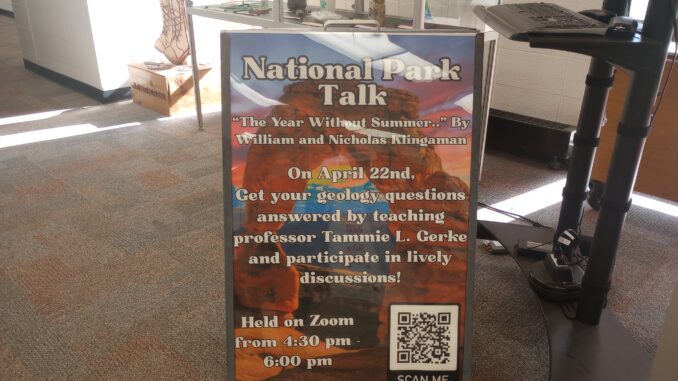
Could you survive a year without summer? Two centuries ago, that happened to be the harsh reality people around the world had to face. Recently, Professor Tammie Gerke presented and discussed the book The Year Without Summer: 1816 and the Volcano that Darkened the World and Changed History, by William K. Klingaman and Nicholas P. Klingaman. During this talk, she reviewed the volcano’s history and its effects, then opened the discussion to participants so they could share their perspective.
At the beginning of the presentation, Prof. Gerke introduced some basic facts about the volcano itself. Mount Tambora is found on the island of Sumbawa in Indonesia. It’s categorized as a stratovolcano (or composite) that formed roughly 57,000 to 43,000 years ago, which is considered young from a geological perspective. The volcano formed from the subduction of the Australian plate, when it was forced underneath the Sunda plate. This created a volcanic island arc. This subduction is steep and is moving at a staggering speed of 3.1 inches a year. Their densities are similar, as the oceanic crust moves below another oceanic crust (compared to the usual convergent boundary of oceanic and continental crust). At some point, the subducted crust becomes warm enough that water separates from the minerals and moves up into the crust above it. The water allows the affected crust to melt, which Prof. Gerke defined as “adding a flux” to lower the temperature. This allows the magma to become less dense and rise to the surface, forming a series of volcanic islands at the side of the subduction zone.
Although the book title mentions 1816, the eruption actually occurred in 1815. The year of 1816, however, was when the weather was the most drastic. Mount Tambora is measured at 7 out of 8 on the Volcanic Explosivity Scale, and its Plinian eruption (characterized by high-reaching columns of volcanic ash and gas) is considered the largest in recorded history. During the eruption, the sheer force blew off its top, reducing Tambora’s initial height of 14,110 feet to 9,350 feet. As the magma vacated its chamber, a massive caldera formed, allowing that part of the volcano to collapse within itself.
A significant part of this eruption consisted of ash deposits that spread across the world. Tambora’s ash column measured 141,000 feet, leaving 36 cubic miles of ash that was carried by the wind. The catastrophic effects of the 1815 eruption are due to the ash and additional gases that were stuck in the stratosphere, which typically takes years to clear, and often results in at least partial blocking of sunlight. This was especially prevalent in places 530 miles within the volcano. Additionally, another disastrous effect was the tsunamis. They crossed the Java Sea and impacted those islands found on the Indonesian archipelago (a chain of islands), with waves estimated at a height of 13 feet. The tsunami’s death toll is difficult to calculate, but most accounts list around 4,600 people dead.
After this information had been presented, Professor Gerke gave additional background by introducing the common volcanic gases: sulfur dioxide, carbon dioxide, and water vapor. While water vapor doesn’t usually present an issue, and carbon dioxide is only occasionally problematic, sulfur dioxide is the catalyst for a tsunami. When sulfur dioxide combines with water, it creates sulfuric acid, leading to acid rain. Tambora emitted approximately 60 megatons of sulfuric gas. One hundred million tons of sulfuric acid followed, when mixed with the stratosphere’s moisture.
The droplets that formed were minuscule and didn’t easily leave the stratosphere, leaving the winds to distribute them globally, thus heavily impacting jet stream behavior. Global jet streams are high-altitude wind currents that circle the Earth in a wave-like pattern, primarily flowing from west to east with consistent dips. In the summer of 1816, these dips were considerably larger and allowed arctic air to move in, generating winter-like conditions during May and June. Earth cooled much quicker than usual as a result; the average temperature dropped 0.7 to 1.3 degrees Fahrenheit.
All this considered, it’s difficult to calculate a precise death toll for those both directly and indirectly affected. For instance, the climate cooling may have led to a new strain of cholera that emerged, which bumped the total number of dead into the millions. The book, in particular, focuses on how the temperature shifted in Europe and affected its populace and culture. 19th-century artists began to capture the abysmal landscape and skies, ushering in a Romantic period. Similarly, writers such as Mary Shelley and Lord Byron were inspired by the Gothic nature of the event.
Wrapping up the presentation, Prof. Gerke explored the post-1815 volcanic activity of Mount Tambora. There were smaller eruptions in 1880 and 1967, and seismic activity did increase from 2011 to 2013. But, the volcano has mostly remained dormant.
As she concluded, the general discussion of the book began. Participants shared their personal opinions, ranging from positive to somewhat annoyed about the tangents the authors took. Some were more interested in the volcano’s physicality and witness accounts than the precise meteorological details. The consensus was that the book was interesting, albeit dense. One member prepared questions to ask the rest of the group that challenged everyone’s memory, while connecting their knowledge to different areas of interest.
Overall, the book club format with a geological twist has been proven successful and hopefully will appear again in the coming semesters.