
By Maureen Wilson —
Our world is a culmination of visual culture. Regardless of how you might define art, it’s impossible to deny that it’s everywhere, and that we’ve become obsessed with various ways of self-expression. It’s like how we study history, meticulously recounting life as it comes and goes. It’s an aspect of humanity, but how much of it is promoted in our education system?
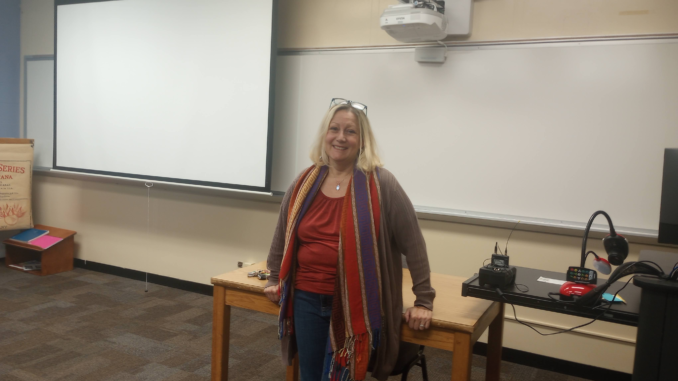
Recently, I interviewed Starla Alexander, who is currently an Art and Classics adjunct professor at Miami University and University of Dayton. She’s taught dozens of different courses for over twenty years—an eclectic mix ranging from art history, women studies, and mythology. Students typically know her for her laidback lectures, interactive assignments, flexibility, and lighthearted attitude. But her stories are how I know her best, and these help to create a unique perspective that she brings to the class, a perspective that could help me understand the longstanding hallmark of humanity that is art.
We had a chance to exchange emails in a question and answer format, and what follows are the highlights of our conversation.
Q: How did you come to develop your interests and subjects of study? What do you believe connects them all?
A: I fell in love with classical art the first time I went to a museum. I went to an Egyptian exhibit at the Toledo Art Museum for extra credit in a survey art history class. She gave two options, so my second trip that semester was at the Cincinnati Art Museum at a Roman Art exhibit. That one felt like I had found home. My love for Greco/Roman was immediate. As a child, I was obsessed with Greek mythology because of the movie Xanadu. I looked up the muses (thank you, Olivia Newton John) and never stopped. My Roman art visit was like visiting with friends. I started college as a creative writing major, but after that trip, I knew I wanted to study art. After having my second art history class with my mentor, Sally, I knew I wanted to do what she did so well.
Art and myth are always related to every time period, every subject. Art reflects the mood of any group of people, and how free it is depends on its leaders. One of my mythology teachers often said, “We have invented nothing.” She is so right. Working people, war, trade, mechanics—everything has been around since Onk the caveman made fire and crude tools. My classes reflect roughly 20,000 years of history that just keeps repeating itself. This has always given me comfort in the fact that I always think down times will get better. I try to show this insight with my students to give them confidence and hope, always presented with a sense of humor!
Q: What do you think has been the most ambitious class trip you’ve taken? Do you believe there have been any particular ones that left a lasting impact on your students?
A: It was actually my last trip. We were in four countries: Germany, Austria, Italy, and Switzerland. I’ve done five European trips with students and I feel like they’ve all had impact. Once students go to Europe, a piece of their heart stays there. Many have returned, and I’ve had two couples get engaged on the trips.
Q: You mentioned several times before how COVID-19 and the pandemic has significantly influenced your teaching. Can you go more in-depth with that?
A: That’s a lot. I made up absolutely goofy assignments. My goal since the pandemic is to teach my students while they laugh. One of their favorite [assignments] is a dating profile for an artist or god/goddess. I also cut down on tests. Smaller assignments towards the end of the term still teach, but without the stress. By the way, most of the people I have taken on trips have never been out of Ohio or on a plane. Forgot to say that.
Q: But presentations for the most part stayed, I’m assuming. Were there any group projects that turned out to be completely disastrous? How did you grade them?
A: The worse things that happen are students bickering. I split them up and have the aggressor or injured party go solo and do an assignment from home. Usually, my students dazzle me every semester with their great presentations!
Q: For a little while, you were an advisor to Middletown’s student newspaper, KAOS. What was that like? Was there any particular column you enjoyed reading from that time?
A: I advised two clubs. Kaos was a blast. I liked student interest stories best. I also founded and advised Pandora’s Box, a classics club. We used to host movies for the campus and the club went to Nashville three times. The first Europe trip was with that group.
Q: To my knowledge, you’ve done a couple of lectures outside the campus as well. What event were you proudest to be a guest speaker for?
A: I presented a paper at Villanova University on the conversion of classical images into Christian images. I really enjoyed it. Also, I visited the museum and walked up the Rocky stairs.
Q: You’re stuck in a time machine that forces you to travel to an ancient Greek time period for a day. Which time period are you picking and why?
A: I wouldn’t travel to Greece. I would travel to the Etruscan civilization because they treated women better!
Q: What would you say are the greatest benefits of learning to appreciate art and human history? Do you think Miami’s required humanities credits should be more commonplace?
A: Learning about any of the arts completes an education. Some like music instead; it depends on the person. I always believe there is a type of visual art that everyone likes. We all have a style. This becomes personal and gives us a feeling of belonging, [so] whoever made it has your taste. History is important. Art reflects it and teaches us important lessons of humanity.