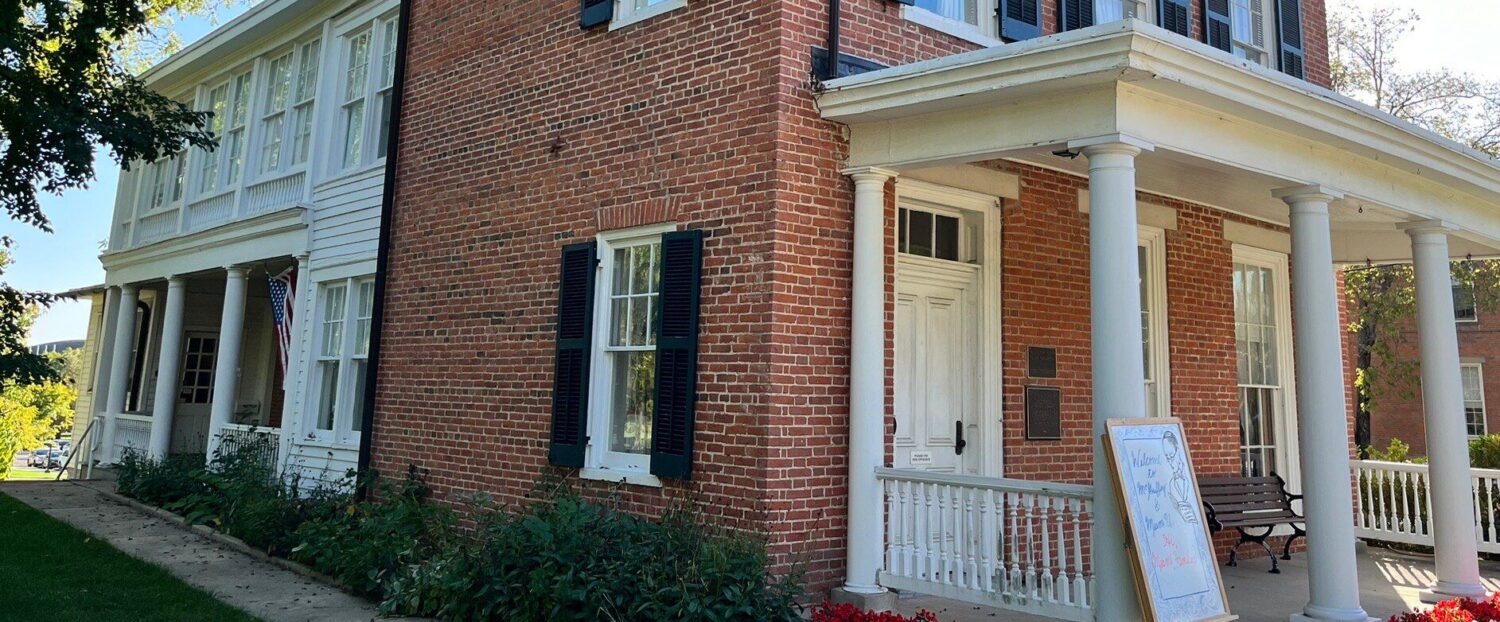
Sometimes, the most mundane artifacts in a museum are the ones that suggest the most interesting stories. On a windowsill in the McGuffey House & Museum sits just such an object.
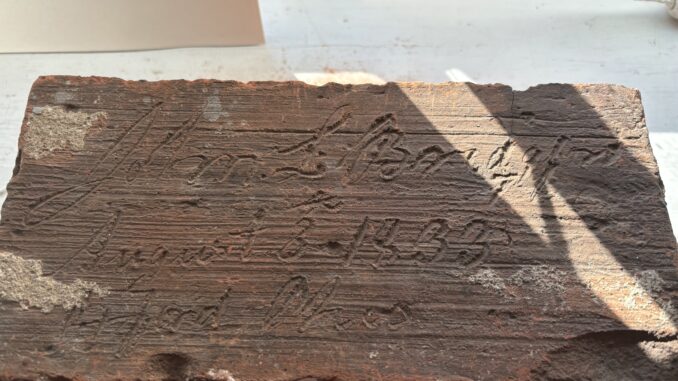
The item appears, at first glance, to be a simple red brick, perhaps more suitable for a door stop than a display. However, a closer look opens a door to the past.
Etched onto the brick, in a simplified version of a copperplate hand, is “John L Bridgford / August 3, 1833 / Oxford Ohio.” The inscription is made with a pointed implement of some sort, similar in effect to the pointed nib sometimes used in period handwriting. This is just the first clue the brick gives to the story of its owner.
John Bridgford (sometimes spelled Bridgeford) appears in the 1830 census as the head of a household in Oxford. From the census, we find that he was between ages 40 and 50 at the time, only a few years William Holmes McGuffey’s senior. An 1836 map of land settlement in and around Oxford confirms the presence of John Bridgford, as do numerous tax assessment records. Bridgford’s existence in Oxford is well-documented.
The brick itself gives us other clues. Bridgford clearly had at least some education, as he could write on this brick with attractive letterforms that were quite legible. He was almost certainly in the brickmaking trade in some capacity, because he had access to this brick before it was dried or fired so that it was impressionable enough to take his signature.
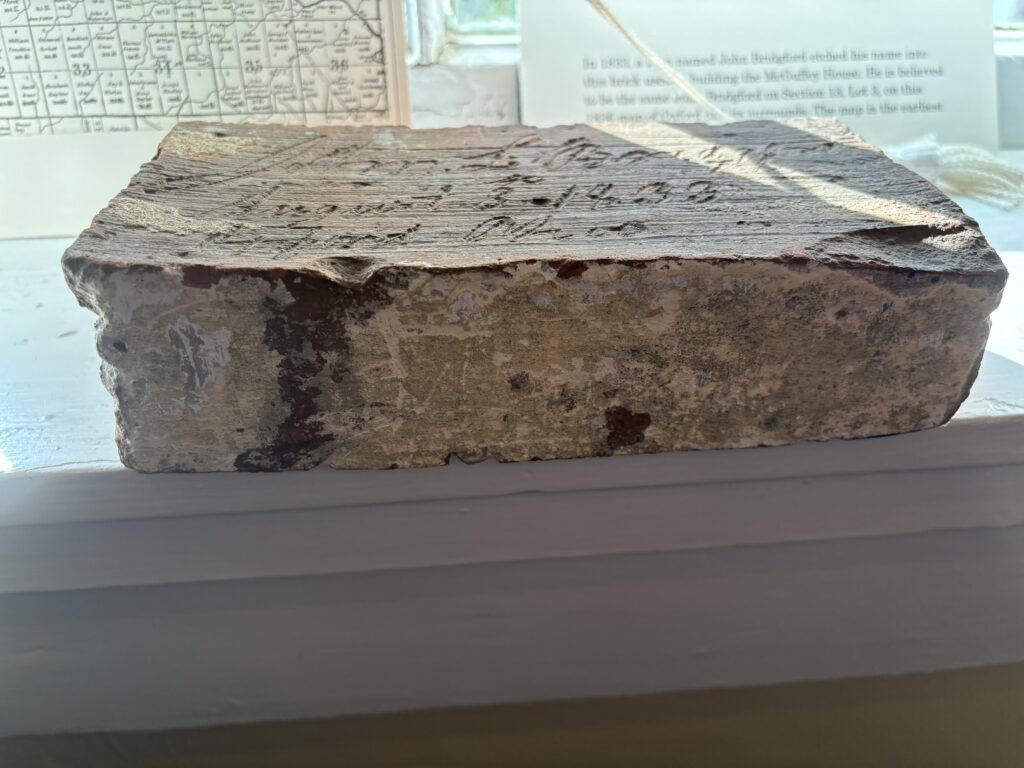
Additionally, the brick itself suggests more about its own use. A worn coat of white paint on one of the faces of the brick hints at the fashion of the time to paint brick houses rather than leaving them natural. We know that McGuffey’s house was originally painted white.
These clues add up to bring alive a man who lived in McGuffey’s Oxford. They were likely brought into each other’s orbit by the construction of this house or one nearby. However, they each are memorialized by their use of writing and education.
Think of that the next time you’re tempted to incise your name into a piece of wet cement. Who knows if that will exist two centuries from now to remind people that you lived.