

By Elynn Severson’s Fifth-Grade Class, Lincoln Elementary, Fargo, North Dakota
Editor’s Note: This post is a vintage treasure from the Dragonfly Magazine archives, originally published in the November/December 1997 issue. Featured below, the story of how a class of inquisitive fifth-graders turned everyday classroom hardware into an engaging investigation of physical science and machinery.
The Spark
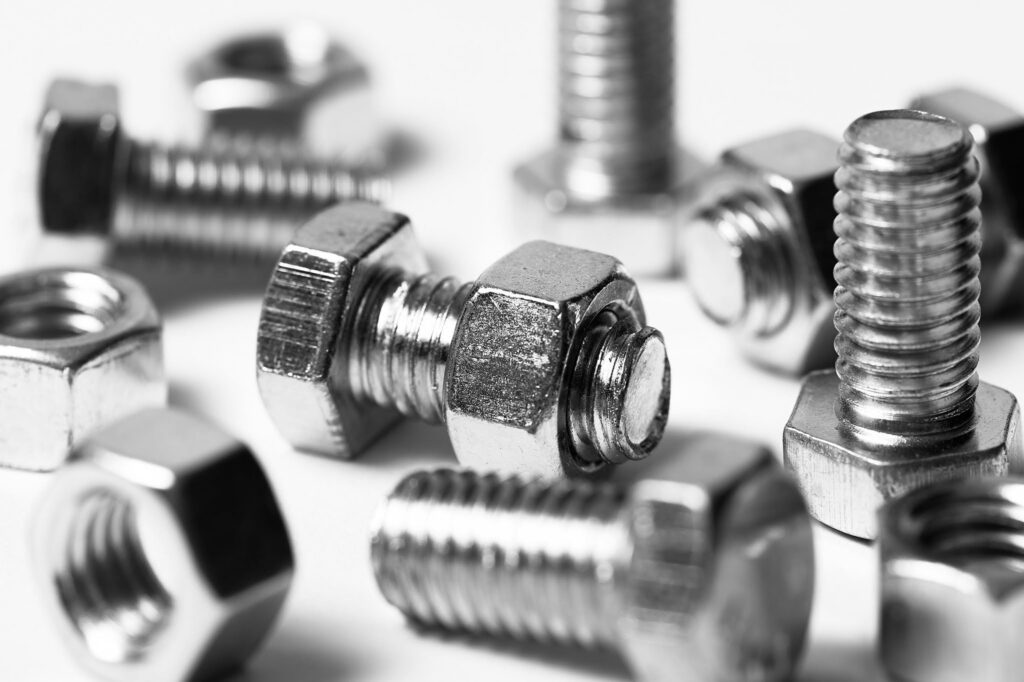
Nuts and bolts are all around us, quietly at work holding our world together. Oftentimes, it’s hard to notice just how dependent we are on these small hunks of metal. And when our class started talking about them, we realized we were getting mixed up! What is the actual difference between a bolt and a screw? Well, to find out, we decided to become “Nut and Bolt Investigators”
Our Prediction
We initially thought finding nuts and bolts in our classroom would be difficult and that most of them would look nearly identical. We also predicted that screws and bolts were essentially the same tool, just inserted with different equipment.
Our Investigation
First, we discussed what we knew and quickly realized we needed clear definitions to classify our findings:
- Nut: A metal block with a threaded hole that attaches to a bolt to hold it in place.
- Bolt: A metal rod with a head at one end and spiral ridges (threads) along the rod used to fasten things together.
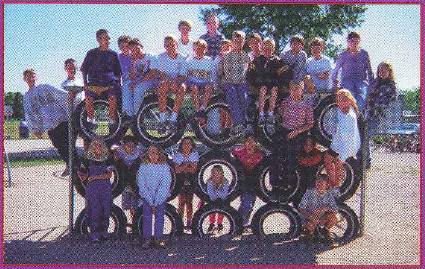
Working in groups of four, each team searched the classroom and schoolyard for examples. We built a classification chart to track the head shape, groove type, size, color, tool required, and specific location for every fastener (metal piece(s) that join two objects together) we found.
Our Results
When we compared notes, all four groups came up with surprisingly similar classification schemes!
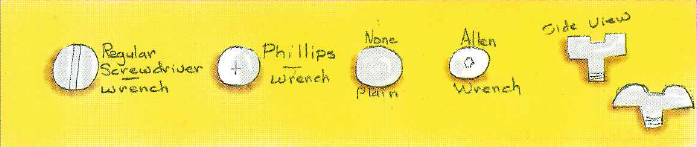
- Design Observations: We categorized four distinct head types: Regular Screwdriver, Phillips, Hexagon (Wrench), and Allen Wrench. On wooden surfaces, we noticed washers were added under the nut to prevent it from pulling through the wood.
- Size Observations: The smallest nut and bolt was hidden inside a wristwatch, while the largest belonged to heavy equipment like bulldozers and snowplows.
- Color Observations: All fasteners were silver metal or painted.
After careful investigation, we realized that our original prediction was wrong! Although screws and bolts do require different tools for insertion, they each hold different purposes. A screw holds materials together by itself, whereas a bolt requires a nut to clamp items in place. Nuts and bolts are selected whenever more holding power is required.
Go Wild: Your Turn!
Look around the room where you are sitting right now. How many fasteners can you spot holding furniture, electronics, or walls together? Count them up and try classifying them by their drive type (Phillips, flathead, hex, or Allen) and whether they use a nut or thread directly into the material.
The Field Guide (Educator Resources)
- Subject/Grade Level: Physical Science & Engineering / Grades 3–6
- Inquiry Focus: Classification Systems, Simple Machines, and Structural Fasteners
- The Science Behind It: Screws and bolts are simple machines based on the inclined plane. The helical threads convert rotational force into powerful linear tension. When paired with a matching nut, the rotational torque creates high frictional resistance and clamping pressure that keeps heavy structures secure.
- Standards Connection:
- NGSS 3-5-ETS1-1: Define a simple design problem reflecting a need or a want that includes specified criteria for constraints on materials, time, or cost.
- NGSS MS-PS2-2: Plan an investigation to provide evidence that the change in an object’s motion depends on the sum of the forces on the object and the mass of the object.
- Materials Needed: Classroom hardware samples, flashlights, hand magnifiers, rulers/calipers, chart paper, and drive tools (screwdrivers, wrenches) for teacher-led demonstrations.