

By the Seventh-Grade Class of Tim Jarboe and Jennifer Leahy, W.R. Coile Middle School, Athens, Georgia
Editor’s Note: Originally published in Dragonfly Magazine in May/June 1997, this article from our archives showcases an incredible student-led inquiry into insect behavior right in a schoolyard. It proves that you don’t need a professional lab to do real science!
The Spark
Our class wanted to find out what kind of food fire ants prefer and just how far they would travel from their nest to reach it. Fire ants have very painful bites, so we knew we had to be careful not to disturb them. We also didn’t want them to abandon their nest just because we were investigating. We searched our schoolyard for the perfect, active fire ant mound—one with fresh soil on top—and found one right near the school building. We decided to test foods that the ants could easily find right in their own outdoor environment.
The Prediction
Because ants are so tiny, we predicted that they would only be able to travel about a single meter from their mound to gather food. When it came to their menu preferences, we thought they would like crickets the best because they seemed easy for them to carry.
How We Investigated
We had to wait for a sunny, warm day because ants are not very active when it’s chilly. Waiting was hard to do in the Georgia spring, but we finally got our chance at 10:30 a.m. on a day that reached 18°C (50°F).
To set up our experiment, we took three pieces of string that were each 6 meters long. We anchored one end of each string at the edge of the mound and stretched them out in different directions, making them look like the spokes of a bicycle wheel. Next, we cut paper squares measuring 10 square centimeters and placed them at 1-meter intervals all the way along each string.
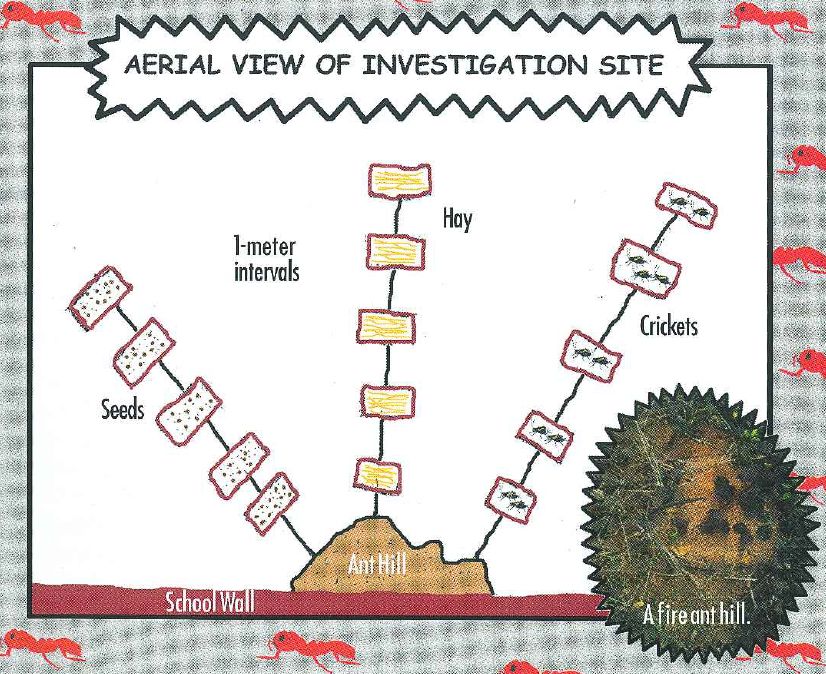
Each string was dedicated to just one type of food: hay, corn seeds, or dead crickets that we collected around the schoolyard. We placed one piece of food on each paper square and left the ants to do their work. After four hours, we went back out to count exactly how many ants were visiting each square.
What We Found
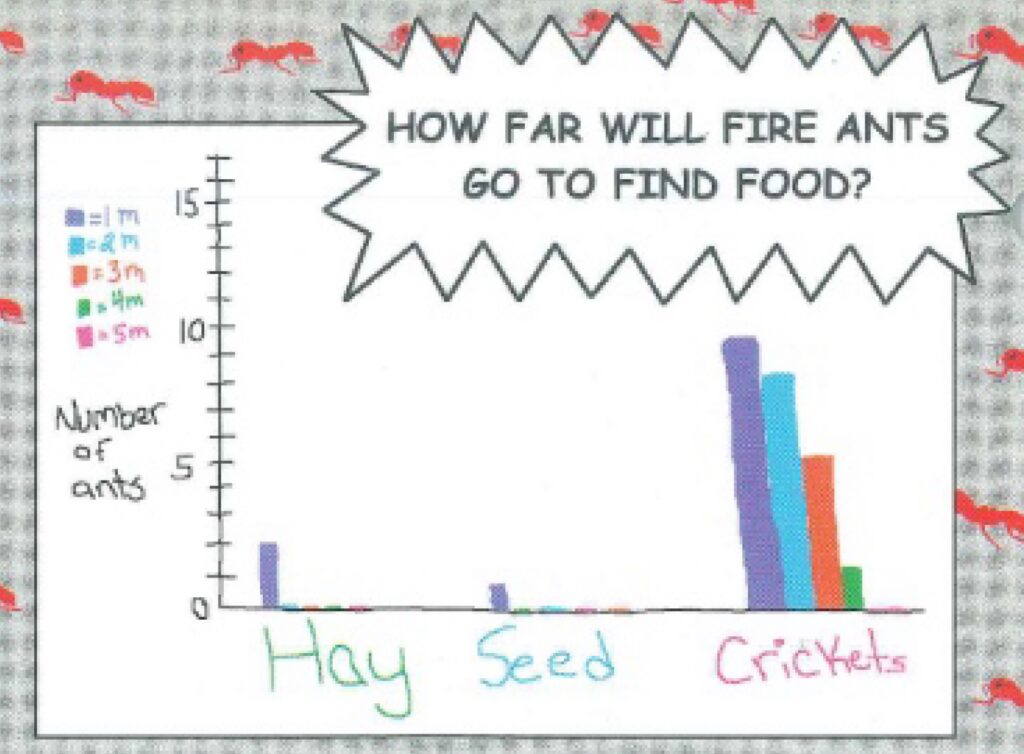
When we collected our data and plotted the results, we were amazed! Our prediction about their favorite food was right on the money: we found far more ants swarming the crickets than any other food source. In fact, almost no ants visited the hay or the seeds.
But the biggest surprise was how far they walked. The ants traveled as far as 4 meters away from the mound to get to those crickets. That was four times farther than we predicted!
Go Wild: Your Turn!
Now it’s your turn to be the investigator! You can replicate this experiment with the ants in your own backyard or schoolyard.
Challenge Variables:
- The Sweet Tooth Test: Would ants prefer sugar water over solid foods?
- The Thermostat Test: Ant activity changes with the seasons. Would you get different results if you ran the test on a hot summer afternoon versus a cool spring morning?
- The Speed Trial: Grab a stopwatch! How quickly do the ants find the first card, and how fast do they move from one card to the next?
The Field Guide (Educator Sidebar)
- Subject/Grade Level: Life Sciences / Middle School (Grades 6–8)
- Inquiry Focus: Experimental design, hypothesis testing, field data logging, and graphing.
- The Science Behind It: Ants utilize pheromone trails to recruit colony mates to high-quality food sources. Protein-rich sources (like crickets) are highly prized for colony growth, especially for feeding developing larvae, which explains why the fire ants ignored the low-protein hay and seeds and traveled extensive distances to harvest the insects.
- Standards Connection:
- Next Generation Science Standards (NGSS)
- MS-LS2-2: Construct an explanation that predicts patterns of interactions among organisms across multiple ecosystems.
- Science & Engineering Practices: Planning and Carrying Out Investigations; Analyzing and Interpreting Data.
- Materials Needed:
- 3 long measuring tapes or pre-cut strings (6 meters each)
- Paper cut into 10 square centimeter cards
- Outdoor markers/pencils and data clipboards
- 3 distinct local food types (e.g., wild seeds, plant matter, dead insects)
- A thermometer