

By Linda Kulas’s Fourth- and Fifth-Grade Class, Guilford Central School, Brattleboro, Vermont
Editor’s Note: Originally published in Dragonfly Magazine in May/June 1997, this vintage treasure showcases how a classic Native American agricultural tradition can bring science, history, and community together in a schoolyard garden.
The Spark
What did people who lived on this continent five hundred years ago actually grow and eat? That was the question that launched our class into a deep study of nutritious foods—specifically corn, beans, and squash—that Native Americans thrived on long ago.
We read a beautiful Iroquois legend about the “Three Sisters” Garden. In the story, three distinct sisters live together in a field: a tiny youngest sister who can only crawl, a middle sister in a bright yellow frock, and an eldest sister who stands tall and straight, protecting them all. As we discovered, these sisters weren’t humans at all; they symbolized beans, squash, and corn.
We wondered if we could replicate this ancient technique right in our schoolyard. Luckily, a parent who is an expert gardener volunteered to teach us about soil nutrition and how to successfully plant our own living web.
The Prediction
We learned that these three plants are completely linked in a web of life. We predicted that if we planted them in tight-knit clusters rather than spreading them out, they would grow better together than they ever could alone. We hypothesized that:
- The tall corn would act as a natural trellis for the climbing bean vines.
- The sprawling squash leaves would blanket the ground to keep weeds out.
- The beans would naturally enrich the soil with nitrogen to help the corn thrive.
How We Investigated
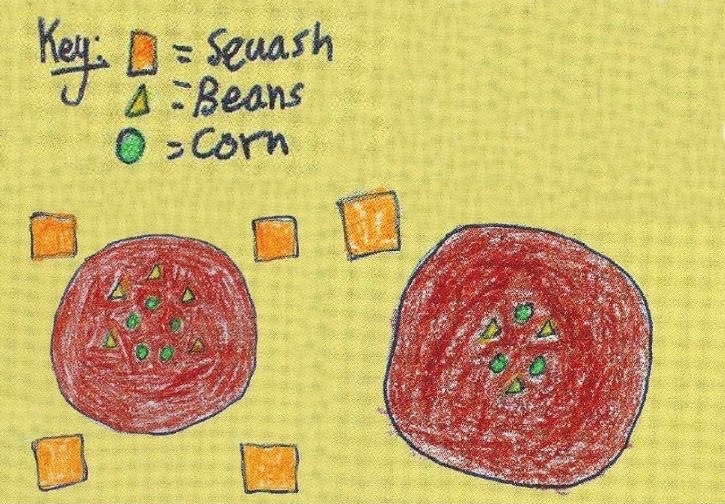
Instead of traditional rows, we utilized dirt mounds (and raised beds) to structure our ecosystem. We had to be incredibly careful with our timing. We planted five corn seeds first. We had to wait patiently until the corn reached about 30 centimeters tall before adding four zucchini squash seeds and six bean seeds into the same mound.
Once our seedlings were established, we thinned each mound down to just one strong zucchini plant and three of the best bean and corn plants. We watered them for a few weeks, let the summer rains take over, and let nature do the rest.
When we returned to school in the fall, our garden was overflowing! Harvesting was an adventure—we discovered that zucchini stems are covered in sharp prickles, which we realized help protect the plant from predators.
We didn’t just harvest; we investigated. We used scales and tape measures to gather data on seven different zucchinis. We also husked the corn ears and counted the kernels for a mathematical challenge.
What We Found
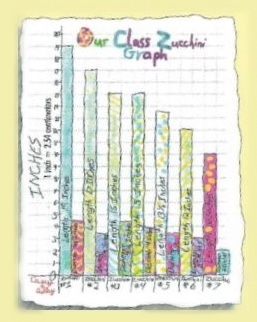
Our garden was a massive success: we harvested six ears of corn and eight massive zucchini squashes. When we analyzed our zucchini data and plotted it on a bar graph, we spotted a fascinating mathematical relationship in nature:
Every single zucchini was much longer than it was wide, and their lengths varied much more than their diameters. In fact, we discovered we could closely predict the length of any zucchini simply by multiplying its diameter by four!
To celebrate, we hosted a Three Sisters Food Festival. With the help of an adult volunteer, we cooked up zucchini bread, corn chowder, and fresh corn on the cob right in our school kitchen, sharing the feast with our first-grade reading partners.
Go Wild: Your Turn!
Can you design a cooperative garden with plants that grow better together than alone?
- The Challenge: Find a combination of companion plants where one species provides a benefit to another—like offering shade, structural support, or natural pest protection.
- Test It: Plant one set of your chosen species together, and another set completely alone. Track which ones grow healthier and produce more food!
- Tip: You don’t need a huge backyard. You can run this experiment using simple plastic buckets on a porch or patio. Choose plants you would love to serve for dinner!
The Field Guide (Adult & Educator Sidebar)
- Subject/Grade Level: Life Sciences / Elementary & Middle School (Grades 3–6)
- Inquiry Focus: Companion Planting, Symbiotic Ecosystems, and Data Modeling
- The Science Behind It: The Three Sisters method is a classic example of indigenous permaculture and biological mutualism. Corn provides structural support. Beans host Rhizobium bacteria in their root systems, fixing atmospheric nitrogen into a usable soil nutrient. Squash develops broad, prickly leaves that act as a “living mulch,” retaining soil moisture and deterring pests and weeds.
- Standards Connection:
- NGSS 3-LS4-3: Construct an argument with evidence that in a particular habitat some organisms can survive well, some survive less well, and some cannot survive at all.
- NGSS 5-LS2-1: Develop a model to describe the movement of matter among plants, animals, decomposers, and the environment.
- Materials Needed:
- Raised garden beds or a small dirt plot (can substitute with large 5-gallon