
By Kathleen Perkins
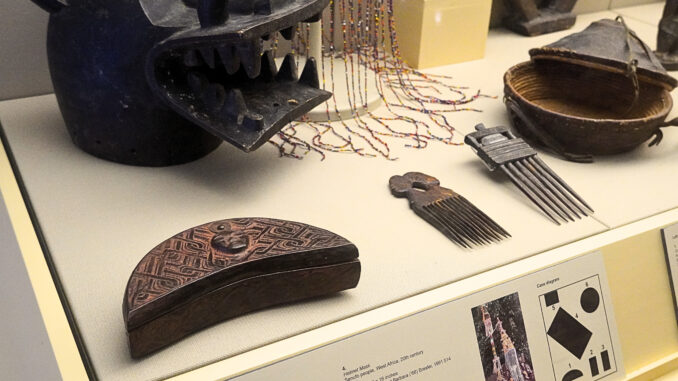
A sign of status and wealth within the Kuba Kingdom, this royal cosmetic box sits on display in the Webster Gallery of the Richard and Carole Cocks Art Museum (RCCAM). Dating to the early 20th century, this cosmetic box was made by the people of the Kuba Kingdom, located in present-day Democratic Republic of Congo in Central Africa.
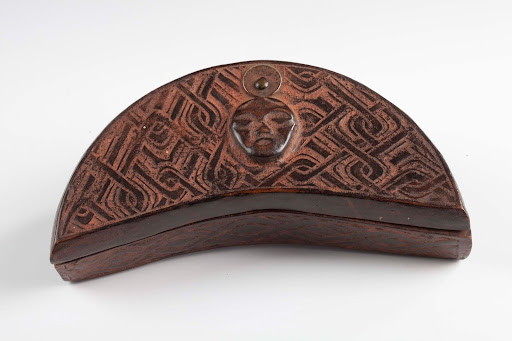
Royal Cosmetic Box, early 20th century
Wood, coin, brass tack, and tuula (iron oxide pigment)
2 x 9 x 4 inches
Gift of Ralph (‘65) and Barbara (‘68) Bresler, 2010.2.54
The Kuba people are well-known for their raffia textiles, used to make clothing, headdresses, and baskets. Raffia textiles often display distinct geometric patterns, seen on this wooden cosmetic box, or ngedi mu ntey. Cosmetic boxes were owned and used by individuals of high status, perhaps indicative of a desire for prestige. Cosmetics, typically applied to the face and chest, are used to anoint the body for an array of medicinal purposes and rituals, including funerary rites.
Half-moon shapes, seen in this ngedi mu ntey, and this example from the North Carolina Museum of Art, are the most common shape of cosmetic boxes in the Kuba Kingdom. This ngedi mu ntey’s lid is secured by a copper coin fastened with a brass tack, located above the raised female face in the design. The face has serene features and blends nicely with the oval shapes found in the geometric patterning. Made of dark wood, this piece contrasts nicely with the vibrant red powder stored within.
Red tukula powder is made from the heartwood of camwood trees (Baphia nitida). Traces of the powder can still be found in this cosmetic box, which may have been used to anoint the body in a variety of ceremonies. Traces of the powder have settled in the recesses of the designs, creating a rich visual contrast. The powder can be used to make a paste when combined with oil to dye textiles and to anoint individuals, living or deceased. Tukula is made by grating two pieces of heartwood against each other, and the paste can also be baked into a brick. These bricks are often incised with similar designs seen on cosmetic boxes and raffia textiles, and are used in funerary rituals.
Tukula is most often used by royals, also suggesting this piece signals prestige and wealth. In addition to storing cosmetics, these boxes have also been used to store razors for cutting raffia textiles, hairpins, or other ritual objects.
Comparables

Kathleen Perkins is a Senior at Miami University majoring in Anthropology and Professional Writing with minors in Archaeology and Museums & Society. Kathleen is currently serving as a Curatorial Intern at the Richard and Carole Cocks Art Museum, and she is also involved in the Anthropology Department’s Collections Management team.
SUPPORT US
Please visit the Art Museum Giving Page and consider becoming a sustaining member or making a donation to support RCCAM’s exhibitions, programs, and collections.
FOLLOW US ONLINE
Access all of our online social media accounts here.