
By Kara Reedy —
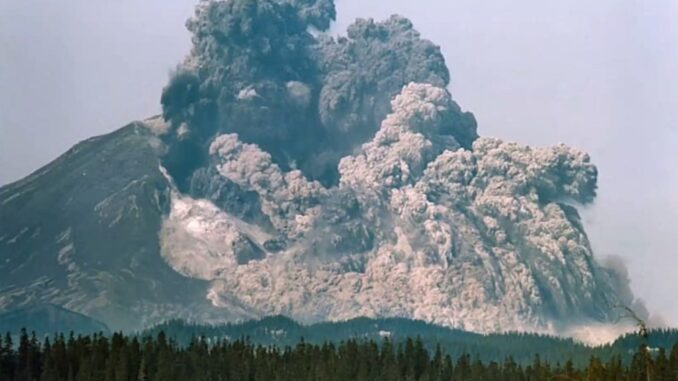
Dr. Tammie Gerke’s National Parks Talk Series has become one of our favorite events, and we always enjoy attending and hearing about the parks in America. This semester’s focus is on volcanoes and their majestic and terrible power. Tuesday’s discussion covered Mt. Saint Helens, which is best known for an eruption that took place in 1980. The surrounding region was devastated by ash and harmful gases, which caused damage to infrastructure. Mudflows from debris reached frightening heights and smothered anything in its path. The cleanup was extensive and took months. However, the destruction, although brutal, enriched the land enough that regrowth and even evolution were possible. The history behind the events on that day not too long ago, as well as everything that happened before and after, is fascinating, and Dr. Gerke didn’t skimp on any of the details.
Mt. Saint Helens formed about 275,000 years ago and is considered one of the Cascade Mountains, which occupy a long stretch of land parallel to the West coast, not too far from the Pacific Ocean. The volcano is suspiciously out of the way of the mountain range, which has confused many geologists over the years. Dr. Gerke mentioned that its position could be the result of being pushed away from the range gradually over the thousands of years it formed. The volcano is the youngest of the Cascade volcanoes. Mt. Saint Helens is a national monument, but it was only deemed as such around two years after the eruption that has made the site infamous. Mt. Saint Helens has been the most active in the Cascade Mountains formation, but it hadn’t erupted in one hundred years when it exploded on that fateful day in 1980. The eruption that many still remember wasn’t even the largest in the volcano’s history, with a previous event occurring nearly 3,600 years ago, resulting in the abandonment of the region by the native populations living nearby. That particular eruption was four times more powerful than the one that occurred in the 80s.
Small eruptions took place in March, leading up to the much larger eruption for which Mt. Saint Helens is remembered. Steam explosions broke through, creating a crater at the volcano’s head that covered the southeastern part of the mountain in ash. These minor eruptions served as a premonition for what was to come. The massive eruption in 1980 that resulted in catastrophic damage to the area began on May 18th with a magnitude 5.1 earthquake, which traditionally doesn’t cause too much damage, but this event was unique: A volcano was involved. The earthquake caused a massive debris avalanche, now considered the largest ever recorded. Almost three and a half billion cubic yards of debris slid off the mountain’s northern side, causing a scar that is still visible today. The volcano erupted when the pressure within was released following the collapse of the north face. A blast nearly powerful enough to rival the wake of supersonic movement exploded into the air in seconds and was heard hundreds of miles away in surrounding states and countries. Perhaps one of the most fascinating aspects of the event is that people closer to the eruption—not those within the area, but people within a few dozen miles—couldn’t hear the blast. The ash cloud created by the eruption reached a height of fifteen miles, causing complete darkness to fall over areas to the north of the eruption.
The eruption of Mt. Saint Helens was brutal and resulted in extensive damage to the surrounding area. Following the event, surveyors of the devastation designated sections depending on the type of harm done to the land. The area termed the Direct Blast Zone sustained the worst damage, with nearly everything within an eight-meter radius being completely eviscerated. This region also had another name: tree-removal zone. The Channelized Blast Zone was the largest impact area; nearly nineteen miles were flattened by the up to 670-mile-per-hour winds being forced out following the release of gas from the volcano. Trees fell flat, ensuring the surrounding land would be nicknamed “the tree-down zone.” The Seared Zone, the last area affected by the eruption, was the smallest in area. Trees standing in this region were singed by the volcano’s gas but remained standing. Some of these trees can still be found today, and the land surrounding Mt. Saint Helens has been recovering for a few decades, evolving into something new and even beautiful.
Volcanic ash is incredibly fertile, ensuring that regrowth is entirely possible in places affected by eruptions. Life has blossomed in the region, allowing plant species to thrive when they never could before. The thinning of the forest allowed for sunlight to reach the lower parts of the surrounding forests, providing nutrients to plant life that had initially been limited. The park’s biodiversity is magnificent, with many new animal species joining a region that has been completely altered to accept all sorts of newcomers. Even geological changes have occurred, with the development of a glacier inside a crater left by the eruption, which is currently one of the youngest glaciers in the world. The beauty of nature always manages to shine, even when blotted by the sadness that comes with intense devastation like a volcanic eruption. The area is very different now, even only a few decades after the explosive event; it almost encourages a sense of hope in the wake of so much change to the rest of nature. The damage done is temporary, and nature will always adapt and grow.
The Gardner-Harvey Library holds events regularly, and if you are interested in attending events like Dr. Gerke’s talk series, then you might be interested in other discussions taking place. November is going to be an especially busy month for interactive events, with the third and last National Park Talk of the semester taking place on Tuesday, November 28th. The discussion will follow the theme for this semester, which is volcanoes, by focusing on Yellowstone National Park. Keep an eye out for the article on that event. Additionally, the Gardener-Harvey Library will be holding an event called the Underground Academy, otherwise known as the National Dishes event. The event will be highly interactive, with dishes being presented during the discussion showcasing the enormous diversity of foods around the world. The event will be held on November 16th. If you are curious about attending the discussion, then please get in touch with the Gardener-Harvey librarians for more information. We hope to see you there!
Contact Information:
Dr. Tammie Gerke – [email protected]
Jessie Long – [email protected]
John Burke – [email protected]