
By Joey Israelson —
As we enter what some consider to be the 4th industrial revolution, one of the biggest advancements in technology is artificial intelligence (AI). AI has been around since the first computers, but it was only recently in the 21st century that the focus has shifted to its development. Everyone knows of Apple’s Siri and Amazon’s Alexa; both are AI meant to be easily used and understood by users, but many are unaware of an even newer AI system, ChatGPT.
ChatGPT was created by OpenAI, a new tech company focusing on AI research and development with the goal of creating AI that can benefit all of humanity. While ChatGPT is their newest AI, it isn’t their first; they are also known for creating Dall-E, which is an AI that can produce images based on a given word or sentences, and Codex, which can generate functional lines of programming in a variety of coding languages.
ChatGPT is currently on its 4th version, trained on information up to 2021. Like Siri or Alexa, it answers questions the user asks, but the answers it gives can be much longer and human-like. This ability isn’t unique to ChatGPT, but what separates this one is its ability to remember answers to previous questions and incorporate that into its responses. While it can give clear and detailed responses to simple questions, it can handle much more advanced queries and can even look at a line of code and identify what’s wrong with it and how to fix it. While not perfect, its answering capabilities are a huge advancement for the world of technology.
The main feature of ChatGPT is the generation of large amounts of text based off a given prompt, and can even mimic the format and design of academic essays. ChatGPT is able to generate accurate responses because the AI is “trained” on different texts and media across the internet to learn what kinds of responses to give. Because many essays have been used to train ChatGPT, it can, in a sense, write its own. Many questions concerning the ramifications of such technology are now being asked. If an AI can almost instantly generate an academic essay, what is stopping students from using this and trying to pass it off as their own work?
While OpenAI is constantly making improvements to ChatGPT, it and other AIs like it still struggle to produce work that could be passed off as human. The AI has other issues as well, mainly that it can’t tell real information from fake, and only has information available from before 2022. These shortcomings don’t mean that students haven’t tried and won’t continue to try to use AI to their advantage. Many professors not just from Miami but around the world have raised their concerns. While the technology may not be perfected yet, the AI is constantly improving, and no one knows how good the AI will be a few years down the line.
Dr. Brenda Quaye is the assistant director for academic integrity at Miami. She sat down for an interview with me concerning AI and its potential use in academic dishonesty. When asked about Miami’s stance on ChatGPT Dr. Quaye said,
“It can be considered either plagiarism or cheating broadly, essentially, using something to produce work in a way that you are not allowed to do or without properly attributing it. We are looking at doing some potential revisions to our policy for next year that would specifically have artificial intelligence mentioned in a couple of different sections just to sort of have it there. It is technically covered under our policy. and essentially, students are using something that they’re not supposed to use, that’s academic dishonesty.”
But this doesn’t mean that AI and ChatGPT can’t be used in work at all. Dr. Quaye also stated,
“Yes, you can use outside sources. However, any outside sources you use, you’re expected to cite and attribute properly, and there are ways that you can cite and attribute use of chat GPT just like you might, you know, an article or a website or a newspaper or something like that.”
There are many different applications for AI besides cheating, and those uses shouldn’t be ignored because some may want to pass their work off as their own. Dr. Quaye suggests that,
“As long as faculty members can think about what makes sense in their classes, and then having those transparent conversations with their students about when it can be used, how it can be used and why or why not, that is good. The potential problems from kind of an academic standpoint come in when a student might just wholesale just use it.”
Some people have raised concerns over the continuous advancements of AI technology, outside of just ChatGPT, although it is one of the first things people point to when covering this topic. Specifically, Elon Musk and a few other big names in the science world have suggested pausing the creation and innovation of AI and considering the possible consequences and risks of continued development. Whether this request will be taken seriously or is even necessary is not certain but is notable regardless.
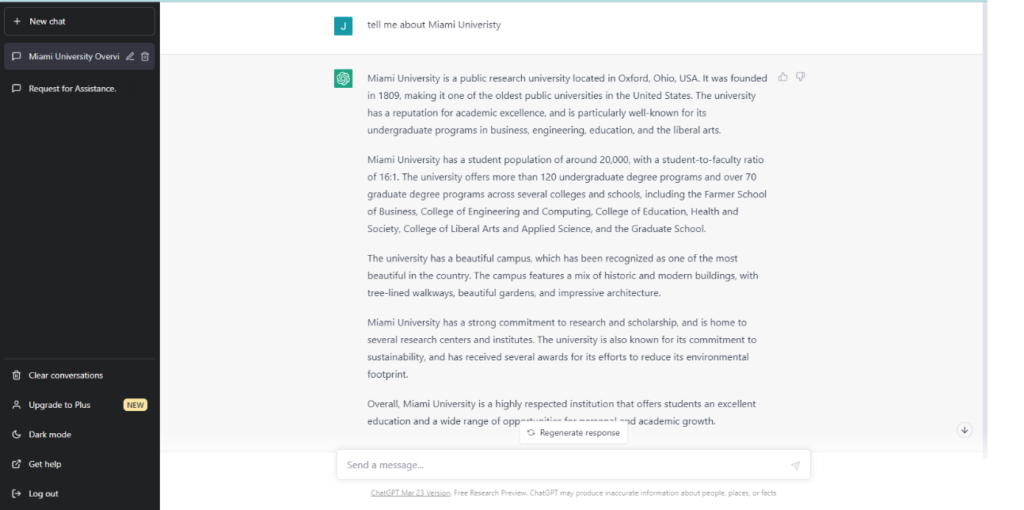
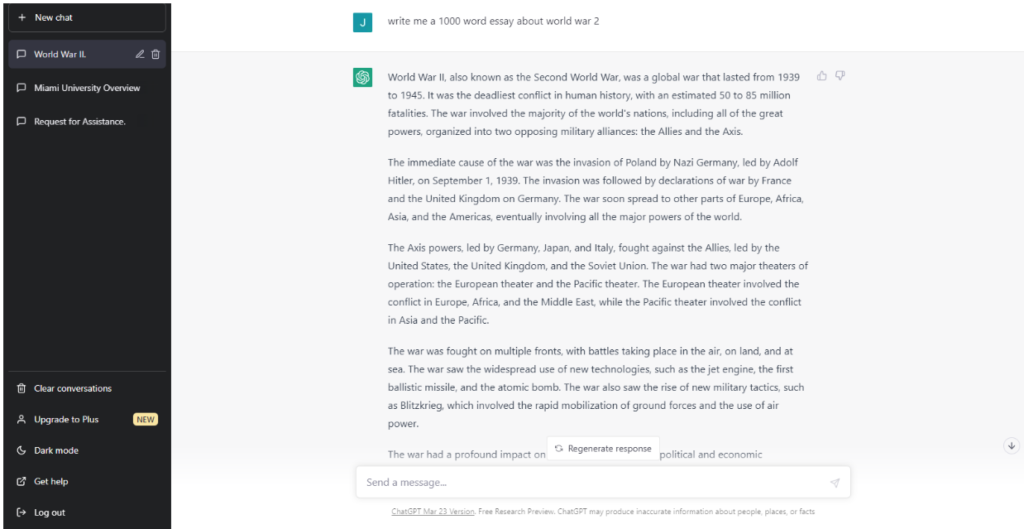
ChatGPT when asked to write 1000 words about WWII, cuts off mid sentence at exactly 1000 words
While a student may not be able to get an entire paper written for them, that technology may not be far off. However, AI still has applications outside of theft. These include coding and cataloging information. It can also still be used in an academic sense as long as it is properly attributed. Those interested in doing so should talk to their professors and look into how to properly cite an AI. For questions concerning Miami’s policy on AI or other questions regarding academic integrity one can contact Dr. Brenda Quaye at [email protected].