
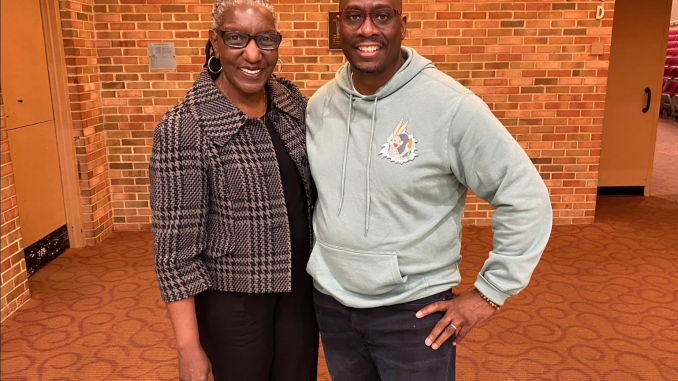
By Olivia Gronvall—
When an audience member first walked into the Parrish Auditorium on November 1st, he or she
would’ve been greeted by a gaggle of people cheerfully chatting away around a table bearing
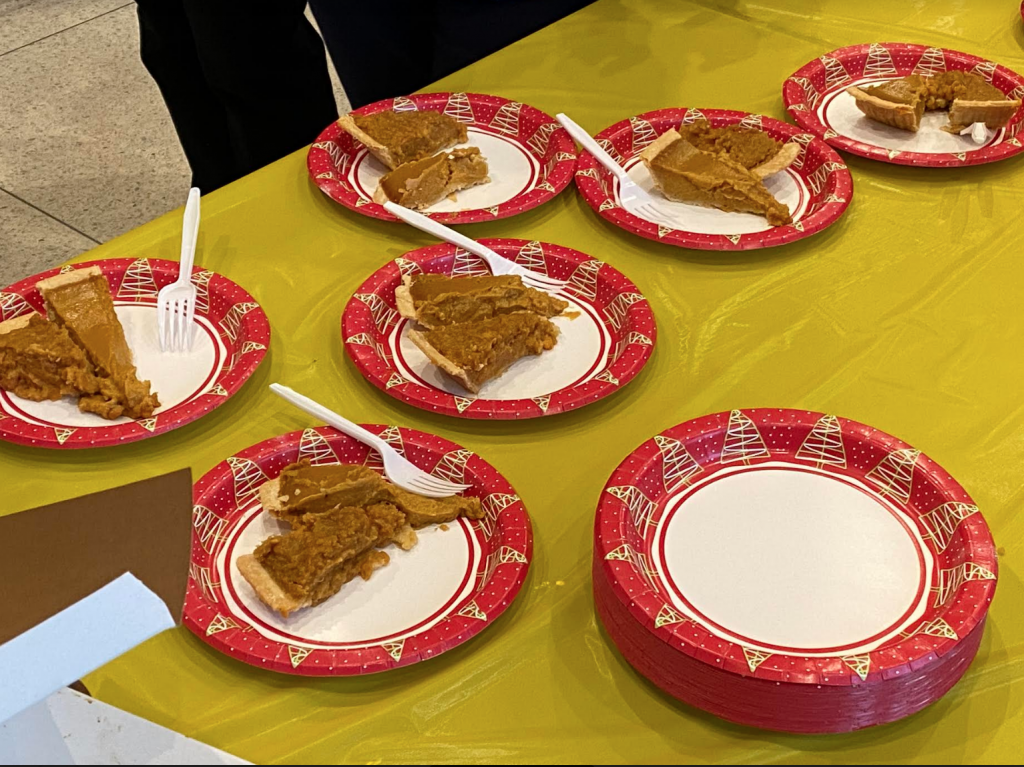
delicious-looking pies generously provided by Hyde’s Restaurant. Anyone there would’ve also
seen the intriguing sight of two slices, each bearing colorful toothpicks, placed on each plate. As
everyone eyed the plates, mouths watering, Regional Director of Diversity, Equity, and Inclusion
Initiatives Dr. Bennyce Hamilton greeted all warmly and with a big smile, inviting them to try
some pie. “We’re having a little experiment here,” she said, “One is pumpkin and the other is
sweet potato, but we aren’t telling you which one is which yet. Try both of the pies, pick the
toothpick of the one you like better, and put it in that jar over there.”
As everyone grabbed a plate and eagerly dug in, they had a difficult choice to make between two
equally delicious desserts. However, perhaps what made this choice easier was memories and
nostalgia; as discussed in the lecture, later on, each person pulled upon memories of similar
desserts he or she had eaten before and of the tastes shaped by one’s family’s cuisine. This
helped each person in choosing the one whose texture and flavor matched most with his or her
experiences.
Little did the group know at the time that this moment was exactly what Dr. William T. Lewis,
Sr. hoped for them to experience, before listening to his lecture about productive conversations
on race and racial legacy in the United States. Discussing the inspiration for and development of
his book Sweet Potato or Pumpkin Pie: Conversations with My White Friends About Race, he
described a personal story about an assumption he had of the pie preferences of both white and
black people to illustrate not only how unique experiences and identity—rooted in culture,
ethnicity, and race–can shape a person, but also how those experiences can encourage
subconscious biases or assumptions, which can limit one’s understanding of others and the
world.
In his family during the holiday season, Dr. Lewis was used to eating sweet potato pie compared
to the typical pumpkin kind. “Early on as a kid, something dawned on me. I thought to myself, ‘I
don’t think I’ve ever seen sweet potato at any big box restaurants during the holidays, or in the
grocery stores, and I don’t recall having sweet potato pie at school events. Even when I watch
holiday movies with a predominantly white cast, I don’t see sweet potato pie as the dessert of
choice.’ So, I started thinking to myself, ‘I wonder if white people only eat pumpkin pie and
black people only eat sweet potato pie during the holidays?’” In his podcast, he discussed
perspectives and assumptions based on race, and he decided to challenge his own assumptions by
asking white people about their holiday pie preferences. He was shocked to find that most of the
white people he talked to—those raised and born in the South—earnestly declared sweet potato
pie as their favorite. “When they said that, I was so lost. I wanted to stop the podcast right there
because I had nothing else to say!” he joked.
Later on, he learned more about the history of the sweet potato pie in the South and how it
connected to the identity of both Southern White and Black people. Sweet potatoes are an
important crop there, and so White people grew up eating it in their cuisine. Additionally, Blacks
who lived in the era of slavery took a liking to the vegetable as well, as it reminded them of the
yams grown in Africa. They took that culinary heritage with them when their descendants
traveled across the United States. Dr. Lewis realized that engaging in healthy conversations with
others, asking questions, is a powerful way to get to know their unique perspectives and life
experiences. In this way, such conversations can help dispel biases and create true understanding
and consideration among individuals, especially concerning the difficult conversations about the
racial legacy of the United States. “It was a good reminder that we need to ask people questions
and not to assume things about a people or group,” he stated.
Additionally, thinking back to the research he did to understand the historical and cultural
context to challenge his assumptions, Dr. Lewis also realized that truly understanding American
history—knowing the hard facts for himself, not just repeating what others say—is crucial for
understanding the racial history and modern racial concerns in modern America. “Often, with
these conversations, we’re not debating facts. We must take out the fake news and be critical
thinkers. You can have a sound argument, a critical thought, and I could still disagree with that
argument, but at least that argument is rooted in common sense; you’re not just repeating what
another said. We should be as knowledgeable about the subject matter as we possibly can–to
know the facts.”
He then went on to explain the importance of knowing America’s long history of racism and
slavery, especially how this past still influences the way race is thought about in the nation today.
He stated that in the end, the most important thing to do in engaging with these conversations is
to not “dehumanize each other” but to “give each other the common respect that we all deserve,”
even when we strongly disagree with one another. Having an awareness of others’ different
perspectives and backgrounds is important too, he argues, as it helps us be aware of things that
we take for granted and how they might be interpreted by and affect others differently from
ourselves. In this way, we can be more aware of the humanity of others and work to be more
considerate, such as in the use of symbols (especially historically complex ones like the
Confederate flag).
These experiences and personal lessons all inspired him to write a book that tried to convey all
that he learned in speaking with his white friends. “When the racial unrest happened around
Georgie Floyd’s murder, I wanted to engage with my friends in a conversation about racism,
rage, and reconciliation,” he explained about the inspiration for the book, “but I didn’t think I
had anything new to offer to the conversation. Yet, I started holding free events for the
community, like watching a movie and then talking together afterward for a debrief of the film.
We had about 200 people gathered online, and that let me know that I was on to something. So, I
continued with that effort …and that lead me to my podcast, Beyond Colorblind, where I
interviewed my white friends about their experiences with race and racism in the United States.
Soon, my friends suggested that I needed to write a book about this.”
At first, he wasn’t sure about writing such a book, but a comment by his wife finally convinced
him that it was the right thing to do. “She told me, ‘William, if you don’t write your book, you’re
going to be selfish, because society needs to hear what you have to say.” As he thought back on
this comment, he smiled, fondly remembering this moment. And so, he made, the choice to
engage with others on these topics rather than to be quiet.
At the end of his lecture, Dr. Lewis discussed what it meant to be an ally for others, both
regarding race and beyond race. Ultimately, he argued that “allyship is not claimed but
bestowed”—not something you claim and “wear as a badge,” but rather the act of being a friend
when no one is watching, being consistent in one’s actions, and being someone that others would
call a friend and ally. He believes that to take a stance against racial injustice in this way takes
being “color-conscious,” not “color blind.” He said that “’not seeing color’ is a great intention,
but in being color blind, you might not see a person in front of you.” In doing so, he hopes that
people can create and perpetuate these important conversations about race, as it is the only way
to not only truly make lasting change, but to prepare for the next eventual impactful racial
situation. The problem, he explained, is that when a crisis such as the one involving George
Floyd happens, the existence of racial injustices are brought to everyone’s attention, but over
time, as everything settles down, people forget about it, and no real progress is made. So, Dr.
Lewis believes that “we should always keep ourselves ready to have the conversation” as it not
only “allows us to help us hear each other before and during the crisis, but that we are ready and
more prepared for the healing that comes after it.”
After the lecture, Dr. Lewis, Dr. Hamilton, Amy DePew, and numerous students interacted with
all the attendees–the Vice President and Dean’s Executive Council Amanda Means, the
Executive Director/CEO of the Hamilton YWCA Wendy Waters-Connell, Regionals faculty
members Dr. Helane Androne, Dr.Theresa Conover, and Dr. Madhu Sinha.
In the end, whether you prefer sweet potato or pumpkin pie, it’s perhaps more important that we
try each one and look at the same thing from many different points of view. What we could
learn from each other might just be one of the greatest experiences in our lives.