
By Paige Auxier —-
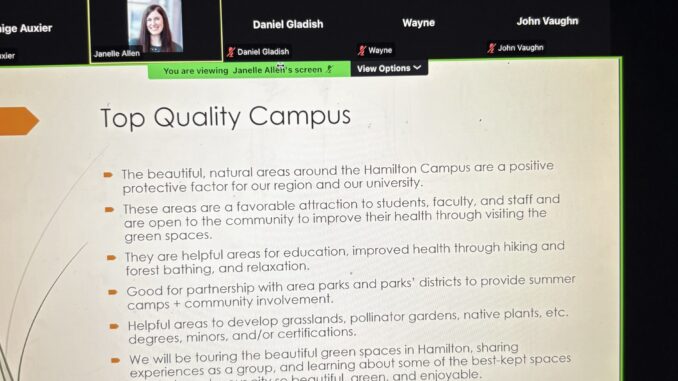
Recently, Miami University Regionals’ Professor Janelle Allen hosted a virtual tour of Hamilton’s green spaces as part of an ongoing College and the Community Series.
During her presentation, Allen discussed the parks, trails, and trees surrounding the Miami University Hamilton campus that are available for students, staff, faculty, and community members to visit. She described three of the area’s largest parksin detail, but also included information about six additional green spaces. Additionally, she prompted viewers to share the names of their personal favorite parks in the area, which in turn created opportunities for audience participation.
Of the parks she described, the three she focused the most on were the Forest Run MetroPark, the Miami Woods Park, and the Rentschler Forest MetroPark—and for each, she shared what made them stand out in comparison to the others by outlining their unique features and amenities.
The Forest Run MetroPark, for example, encompasses 342 acres of land, on which there is a creek, a prairie, meadows, woods, and wetlands. While there, visitors can bird watch, fish, hike, and bike. There are picnic tables, playgrounds, restrooms, and water fountains as well. There is also an observation deck on which visitors have the chance to enjoy an aerial view of the park’s beautiful prairie, woods, and meadows.
The Miami Woods Park is smaller in comparison to Forest Run— only 100.9 acres—but it is advantageous for its slightly nearer vicinity to the Hamilton campus. It’s not without its own unique amenities either, which, according to Allen, include hiking trails, sculptures, a practice golf range, a pond, and a fountain.
The last of the three areas Allen extensively described was the Rentschler Forest MetroPark. She said that this park is one of the oldest in the Butler County MetroPark system, and a favorite amongst community members. The park encompasses 125 acres of land, on which visitors can enjoy walking along the 13.8 miles of what Allen characterized as “primitive trails.” They can also utilize the playgrounds and picnic shelters, or canoe on the Great Miami River. Additionally, the space accommodates activities such as bird watching, fishing, geo-catching, and paddling. There are several facilities and amenities available for visitor use, too, which include flush toilets, grills, outdoor shelters, picnic tables, and playgrounds.
Allen was also sure to accompany her descriptions of these spaces with the positive effects these spaces can have on the community and environment: certainly the health and well-being of visitors, the research opportunities they create for university staff and students, and their positive impact on the environment.
To ensure these green spaces remain preserved so that the environment and community can continue to benefit from them, it’s imperative that residents of the surrounding areas be aware of, visit, and talk about them. In the coming months, as the weather warms and such ventures grow more appealing, Prof. Allen encouraged her audience to make an effort to visit these spaces. And, for those looking to learn more about the area’s green spaces or to share what their personal favorites are with members of their community, feel free to attend the next event in this series, happening either online via Zoom or at the Hamilton Downtown Community Center, on April 4th at noon.
Leave a Reply