
By Clare Sherman —
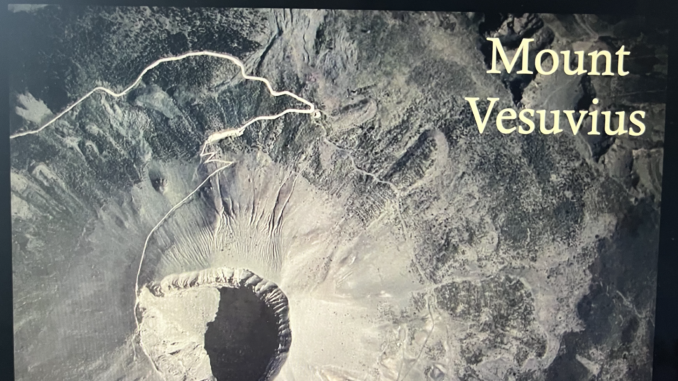
In a recent Zoom gathering, Dr. Tammie L. Gerke hosted the latest installment of the National Parks series. Despite the name, the program has evolved to hone in on the community’s broad geological interests, which don’t always involve national parks. Volcanoes are the recurring theme for the Spring 2026 semester, and this particular presentation focused on Mt. Vesuvius.
Before the presentation began, Dr. Gerke and the audience had casual conversation about the weather and community events. Head Librarian for the Gardner-Harvey Library, John Burke, announced upcoming events at the library, including a book discussion with the MUM Book Club on March 27th. Additionally, Dr. Gerke reminded participants that April’s National Parks event will cover “Krakatoa: The Day the World Exploded” by Simon Westchester. Participants were reminded that reading the book is not mandatory for attendance.
Dr. Gerke’s presentation covered a vast range of topics related to Mt. Vesuvius. Starting with general geologic topics related to volcanoes, she reviewed plate tectonics. Next, Dr. Gerke went over volcanic hazards and features of Mt. Vesuvius and surrounding volcanoes. To conclude, she spoke about the volcanic eruptions in Pompeii and Herculaneum.
When discussing plate tectonics, Dr. Gerke detailed how convergent plate boundaries—meaning tectonic plates that collide—lead to the formation of volcanoes. The denser plate slides under the other in a process called subduction. Trenches form in these environments, and it is here that ocean water is exchanged between plates, flux melting occurs, and magma is generated. The end result is a continental volcanic arc, or a string of volcanic islands.
Next, Dr. Gerke went over the different features of volcanoes. Volcanoes are either called a shield or a composite/strata, depending on how they’re formed. Shield volcanoes are rounder and get their name from a similarly-shaped Roman shield, while composite/strata volcanoes are the more popular triangular shape with alternating layers of ash and rock. Volcano eruptions are either effusive or explosive, with effusive defined by low gas content and fluid magma flow, and explosive meaning high gas content and violent bursts of magma and ash. Participants would later discover that Mt. Vesuvius’s eruption in Pompeii was both effusive and explosive, depending on which phase it was in.
After learning the different volcano traits, participants discussed the direct and indirect hazards of volcanoes. Lava, ash, landslides, pyroclastic flows, and lahars were listed as direct hazards. Pyroclastic flows, which are columns of toxic ash, were noted to be one of the most dangerous hazards, second only to lahars. Lahars form when water mixes with toxic volcanic ash of pyroclastic flows, and it creates a mixture that Dr. Gerke compared to wet concrete. Lahars rush down inclines at fast speeds, damaging structures and homes. As for indirect volcano hazards, Dr. Gerke stressed that both harmful, escaped gasses and tsunamis caused by eruptions are just as important to be aware of.
Dr. Gerke then discussed the volcanism around Naples. In addition to Mt. Vesuvius, this also included Campi Flegrei and Mt. Somma. Interestingly, the group discovered that Mt. Somma and Mt. Vesuvius is connected, because Mt. Vesuvius grew inside a sunken remnant, or a caldera, of Mt. Somma.
To conclude the presentation, Dr. Gerke shared how the cities of both Pompeii and Herculaneum were affected by a Mt. Vesuvius eruption in 79 AD. The eruption, which only lasted about two days, had two distinct phases and ended up covering Pompeii in over 20 feet of ash. Although many people believe that Mt. Vesuvius killed essentially all of the city’s residents, Dr. Gerke revealed that many people escaped during the milder phase of the eruption. Interestingly, the people who passed away didn’t suffocate like most believe. Rather, deaths were a result of the 480-degree heat reaching up to six miles away.
Herculaneum was destroyed alongside Pompeii in 79 AD, and was discovered around 40 years earlier than Pompeii in 1709. Because it was a smaller vacation town for the elite, Herculaneum was less impressive to historical records. Thus, most artifacts like murals are left untouched. Dr. Gerke has visited both towns and admitted that Herculaneum is more enjoyable than Pompeii because of how many of Pompeii’s artifacts live elsewhere in museums.
The National Parks Talk Series will return for the final time this semester on April 21st. Simon Winchestor’s book, “Krakatoa: The Day the World Exploded,” will be the main topic of discussion, although reading is not mandatory. To stay updated on all Gardner-Harvey Library events, click here.
Leave a Reply