
By Ally Duffy —
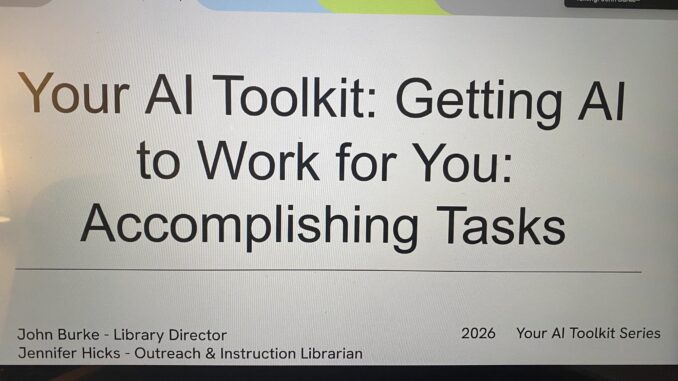
Recently, Miami University Middletown’s library director, John Burke, and the outreach and instruction librarian, Jennifer Hicks, hosted a presentation as part of the ongoing “AI Toolkit” series at the Gardner-Harvey Library. In this session, Burke and Hicks focus on how AI can work as an assistant and also introduced specific applications and their possible uses.
Mr. Burke began the presentation by stating that AI is more than a chatbot, and should instead be considered an agent, as it can complete independent activities on command. While AI is capable of being useful in many tasks, Burke made sure to speak to the limits of AI. Specifically, he discussed AI’s inability to perform a task without being initiated by an individual, and also how it may fall short when reviewing final content created by a user.
Following the introduction, Burke discussed how AI could be used in brainstorming. For writers, there may be times where it becomes difficult to find ideas for possible topics, angles, or creative approaches. Mr. Burke outlined possible AI options that could be useful. Specifically, Google Gemini acts as a cross-disciplinary collaborator for many brainstorming activities in any subject. Burke depicted this by walking the audience through utilizing the AI and showing its capability to be a useful assistant while in the brainstorming phase of writing or creating other content.
Next, Ms. Hicks introduced the next subtopic related to AI: the task of writing itself. She spoke to AI’s capability of assisting with drafting, editing, and refining an individual’s writing. The first application introduced for this task was ChatGPT. Hicks explained that ChatGPT can be utilized as a writing partner by helping with brainstorming topics, outlining ideas, improving clarity, or polishing up a draft.
Additionally, Hicks introduced a code writing AI, Claude Code, that is useful for developers as they write, edit, explain, and troubleshoot code. Ms. Hicks was clear that she is not an expert on coding, but she did introduce a YouTube video that explained it more thoroughly: “Why We Are Crazy About Claude Code”. Ms. Hicks also highlighted that Claude Code has the capability of creating a website based on criteria dictated by the user.
Mr. Burke then began to highlight how AI can explain complex topics, summarize articles, and suggest search strategies. Prior to introducing the applications available for this section, Burke discussed the difference between a simple Google search and an AI chatbot. While Google search can be a good, general discovery tool, an AI chatbot can be used as a task tool that functions more like an interactive assistant by explaining and summarizing content.
Mr. Burke then introduced two AI tools for the role of assisting in research: Perplexity and Google NotebookLM. Perplexity can be used to suggest topic ideas and search terms; it also provides links to the sources. Google NotebookLM synthesizes and summarizes documents you upload or link to the AI tool. It can also be used to create videos and flashcards from the documents provided. Along with the possible AI research tools, Burke reminded the audience of Gardner-Harvey Library’s AI Research Guide, which outlines suggested techniques when using AI tools.
Next, Mr. Burke introduced the concept of organizing tasks with AI tools. He stated that AI can assist in breaking down large projects into smaller and more manageable steps by creating to-do lists and timelines. He also reviewed the many uses of “Goblin Tools” as an assistant in preplanning, rephrasing, and even assisting in working through decisions a student would need to make. These tools represent a collection designed to help neurodivergent individuals with various tasks they may find intimidating or overwhelming.
Next, Ms. Hicks moved on to the issue of creativity by introducing FreePik and Lovable. Since AI can support creativity by generating images, ideas, and designs, FreePik can create AI images based on the criteria the user inputs into the prompter. Additionally, Lovable allows the user to build websites and apps by inputting the user’s idea into the prompter.
As the presentation came to an end, Ms. Hicks highlighted the fact that AI, when used appropriately, can be a powerful assistant that can make tasks easier, but it is certainly not meant to be a replacement for critical thinking or originality. The key to utilizing AI effectively is learning to ask good questions, and to use it only as a tool of support.
Leave a Reply