
By Clare Sherman—
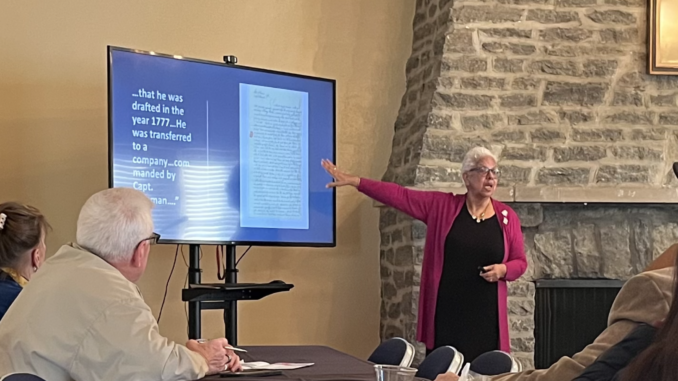
The Verity Lodge at Miami Middletown recently hosted Frances McGee-Cromartie, who spoke about how she uncovered the history of her African-American relative, Henry Dorton, a Revolutionary War soldier. “Finding Henry Dorton” is one of several public programming events at Miami Regionals celebrating the United States Semiquincentennial.
A former assistant prosecuting attorney and Common Pleas Court Judge in Dayton, Ohio, McGee has been a proud member of the Daughters of the American Revolution (DAR) and a Commission Member of the America 250 Board in recent years. At the beginning of her presentation, McGee spoke about her mother, who was dedicated to learning her family’s genealogy. After her mother passed away, McGee took a new interest in her family’s history, realizing that she “should have asked the questions that we need to ask.” She credits her mother for her recent journey towards uncovering her family’s past.
Henry Dorton was first introduced to McGee in the early 1980s, when a relative, Bernard Mayhle, visited her family after compiling a genealogical work titled “The Males of Barbour County, West Virginia.” He informed the McGees of Henry Dorton, accompanied by some interesting advice. Considering that James H. McGee, Frances’s father, was mayor of Dayton at that time, Mayhle suggested that James tell the public that Dorton was white, so that it seemed as though the McGee family married into black lineage. Her dad refused.
Fast forward to 2016. McGee was at a meeting for the Lawyers Club when a colleague mentioned she belonged to the DAR organization. Knowing her relation to Henry Dorton, McGee stated that she was thinking of joining, and a fellow attorney said, “You must be mistaken; there were no black soldiers in the American Revolution.” This was the moment that sparked McGee’s historical research.
With comprehensive evidence from court documents, censuses, and newspapers, McGee then relayed the story of Henry Dorton. In 1749, Dorton’s mother, Ann, gave birth out of wedlock, resulting in a charge of “bastardy.” Her sentence was indentured servitude, which means she was held to a contract for unpaid labor. By extension, Henry was also charged with indentured servitude of 31 years at 6 months old.
When Samuel Pruitt, the man Henry was indentured to, wrote his will, he “gave” Henry to his wife to ensure the 31 years would be used up. However, when Pruitt died, his wife remarried, and all ownership belonged to her new husband. Because the will never mentioned the new husband, and Mrs. Pruitt now couldn’t own anything herself, Dorton was able to go to court and dissolve his servitude early.
McGee then recounted the three times Dorton was drafted during the Revolutionary War, using information from Dorton’s pension application. In 1777, Dorton was a part of Captain Foreman’s company; during this time, 20 company members died in an attack after poor planning on Captain Foreman’s part. After his military time was completed, Dorton kept his official discharge for 51 years, and McGee included pictures of the actual paper. Dorton was also drafted in 1778 and 1781. During his service in 1778, McGee unveiled that he was discharged from his company right before a brutal siege, where the men were boiling shoe leather to eat because they were so starved.
When discussing the rest of Henry’s life, McGee told stories of the long process towards becoming a US citizen. Because one couldn’t become a citizen unless that person owned land, Dorton was not able to obtain citizenship until his 80s. McGee also mentioned the troubles Dorton encountered when proving his eligibility for a pension in the 1830s. Even when he finally got his pension for serving, the amount was greatly reduced. Finishing up the presentation, McGee took the audience through her family tree, starting at Henry Dorton, and ending at herself.
Throughout the presentation, McGee expertly drew from and interpreted various historical documents, saying she prepared her research like she would for a case. McGee also spoke to the larger movement of recognizing African-American Revolutionary War soldiers, citing the Civil Rights Movement and the Black Consciousness Movement as the beginnings of this interest. A DAR publication, McGee recommended Forgotten Patriots to the audience, which recognizes over 6,000 names of African American and American Indian patriots in the Revolutionary War.
At the event, Dr. Matthew Smith spoke about the several historical public programming events coming up at Miami Regionals. On April 14th, Richard Brookhiser, American historian, journalist, and biographer, will speak at Parrish Auditorium. To stay updated on all public programming events at Miami Regionals, click here.
Leave a Reply