
By Clare Sherman —
The Gardner-Harvey Library’s National Parks Talk Series returned for the semester recently with an informative lecture by Geologist Dr. Tammie Gerke. Zoom participants tuned in for a comprehensive look at Iceland’s volcanoes.
The National Parks Series has evolved in recent years from presentations about the National Parks to the participating community’s geological interests. The theme for the current spring semester is volcanoes, with the first lecture focusing on Iceland’s volcanic activity. At next month’s meeting, the group will learn about Mount Vesuvius, followed by a group book discussion of “Krakatoa: The Day the World Exploded” by Simon Winchester in April.
Today’s lecture, which had an impressively large Zoom audience, began with an overview of the topics to be discussed, including plate tectonic review, Iceland’s formation, volcanoes and glaciers, and even folklore. Dr. Gerke, excited to share her research, encouraged all participants to comment and ask questions throughout the evening.
To ensure the audience’s understanding of the Iceland-specific topics to come, Dr. Gerke began with a plate tectonic review. The types of plate boundaries—divergent, convergent, and transform— were explored. Iceland sits atop a divergent plate boundary, meaning that the North American and Eurasian plates are spreading apart at approximately two centimeters per year. It is the only country in the world with a major divergent plate boundary—the Mid-Atlantic Ridge—above sea level, and people can hike between the plates at Þingvellir National Park.
Adding to Iceland’s complex and active geology is a major hotspot, which sits right on the Mid-Atlantic Ridge. This unique situation leads to many heavy, dense Basaltic rock eruptions. The added weight of Basaltic rock causes the folding and rising of the surrounding crust, accounting for the above-sea Mid-Atlantic Ridge. This interaction between the hotspot and the tectonic plates caused the intense volcanic activity that created Iceland.
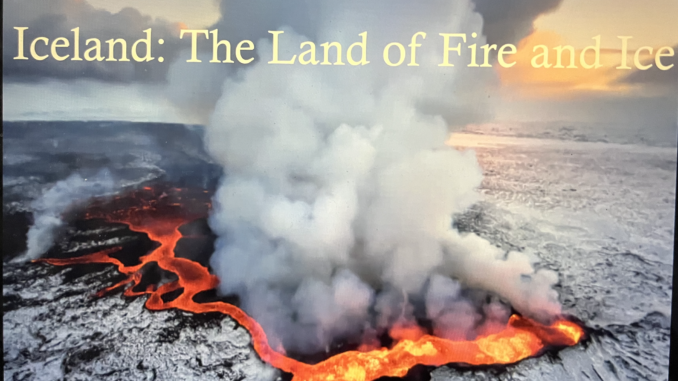
Dr. Gerke also touched on the fire and ice dynamic of Iceland’s volcanic activity. Because the island’s surface is 10-11% glacier material, Iceland’s most active volcanoes sit directly on top of glacial ice. Interestingly, the interaction with ice inhibits the formation of the volcanoes, causing them to take a “table-top shape” as opposed to the triangular shape of most volcanoes. The interaction of fire and ice also leads to flash floods when volcanoes erupt, and they are often just as devastating as the eruptions themselves.
Notable facts and famous eruptions of five of Iceland’s most well-known volcanoes—Katla, Eyjafjallajökull, Hekla, Laki, and Fagradalsfjall—were discussed in detail. Dr. Gerke cited Katla as the most active and explosive volcanic system, with eruptions occurring every 40-80 years. Eyjaffjallajökull, whose magma system is connected to Katla’s magma system, is most famous for its March 20th, 2010 eruption. Over 20 countries were affected in the aftermath, totaling billions of dollars in economic damage. In a historic fun fact, Dr. Gerke revealed that the crop failure associated with Laki’s 1783 eruption is speculated to have been a trigger for the French Revolution.
Folklore concluded the presentation, as Dr. Gerke spoke about Huldufólk. Translated to “Hidden People,” Huldufólk are mythical beings believed to live in volcanic environments. A large percentage of Icelanders have long believed in and respected Huldufólk, seeing them as protectors of the land. Land and construction projects have even been altered to avoid disturbing their peace.
Throughout the comprehensive lecture, Dr. Gerke’s passion for Iceland’s geology showed through. In addition to enthusiastically teaching the material, she also revealed that some materials were new even to her, expressing appreciation for opportunities to make discoveries and share them with the community. Furthermore, the participants were actively involved with comments and questions, and at the end of the evening, one participant shared stories and photos from her trip to Iceland. Many tips were shared for those wanting to go themselves.
The National Parks Talk Series will return on March 17th to learn about Mount Vesuvius, and on April 21st to discuss “Krakatoa: the Day the World Exploded,” by Simon Winchester. To stay updated on all Gardner-Harvey Library events, please visit their event calendar.
Leave a Reply