By Hope Nickel
University president, Presbyterian minister, local grave resident. Andrew Dousa Hepburn is all things and more, though the average Miami-goer likely recognizes his name from the residential hall titled in his honor. The man now buried six feet under, eternally resting as the ground above him thrums with the hustle and bustle of students scurrying to class, witnessed the same liveliness of the same college town over a century ago when, among the many eras in his life, he was a professor and eventually president of Miami University.
Unlike McGuffey, by the time Hepburn came to Miami as a professor of English Literature in 1868, he already had a seasoned career (and reputation) under his belt. As a young adult, Hepburn had a busy college career. He began his higher education at 14 years old, and attended four different schools, bouncing between Pennsylvania, then Virginia, then New Jersey, before finally becoming an ordained Presbyterian minister and leading a church in New Providence, Virginia starting in autumn of 1858, after about thirteen years of higher education. Through this edification, he had a background in moral philosophy, various languages, English literature, and more that would guide his professional career for the rest of his life. In fact, William Holmes McGuffey taught Hepburn moral philosophy at the University of Virginia, through which he would meet his wife, the daughter of McGuffey, Henrietta. They would have two children together by 1859, within the first two years of their marriage.

After a few years of solely focusing on his duties as a pastor, Hepburn took up a professorship at University of North Carolina, teaching metaphysics, logic, and rhetoric, though by this time, it was 1860, and Hepburn’s world was about to become a lot more hectic with the coming of a civil war.
It was 1864, and the situation in the South was falling apart. Grant’s Overland and Petersburg campaigns alongside Sherman’s Atlanta and Carolinas campaigns were constricting the Confederacy as inflation drastically rose. Despite heavy Union casualties, the Confederate Army was becoming increasingly weaker and more desperate. In autumn of that year, Hepburn decided to take a leave of absence to become an interim pastor for the First Presbyterian Church in the port town of Wilmington, North Carolina.
Despite the Union naval blockade, Wilmington was extremely important for smuggling supplies, as it was the last remaining major Confederate port, and the town boasted the largest Southern earthen fort. If Wilmington fell, the Confederacy would fall with it. And so, the Union began their bombardment of Wilmington’s Fort Fisher on Christmas Eve of 1864. Hepburn would have heard the shelling exchanged back and forth between the behemoth siege and naval artillery. Although a major general would surrender the fort and the mayor would hand over the city, it was Hepburn who led a civilian delegation to negotiate the surrender of Wilmington.
By 1868 after bouncing around a few different cities, Hepburn landed himself in Oxford, Ohio after being offered a position in English Literature. For Hepburn’s wife Henrietta, this was a homecoming. She was born in Oxford and lived in the McGuffey House for around three years of her early life until her father moved the family down to Virginia following her mother’s death. After a few years, in 1871, Hepburn became Miami University’s president for two years until the institution shut down due to financial troubles and low enrollment. Ironically, having a more financially cushioned position at Miami after the tumultuous war was Hepburn’s original reason for moving out to the Buckeye state.

Eventually, Hepburn moved back to Ohio in 1885 to restore his position as a professor in English Literature when the University reopened. There he stayed through his death on Valentine’s Day of 1924 as a result of bronchial pneumonia. Henrietta passed away a year later. Despite having lived in many places throughout his life, the couple made Oxford not only their final place of residence in life, but also in death. The Hepburns’ graves lie in Oxford Cemetery.
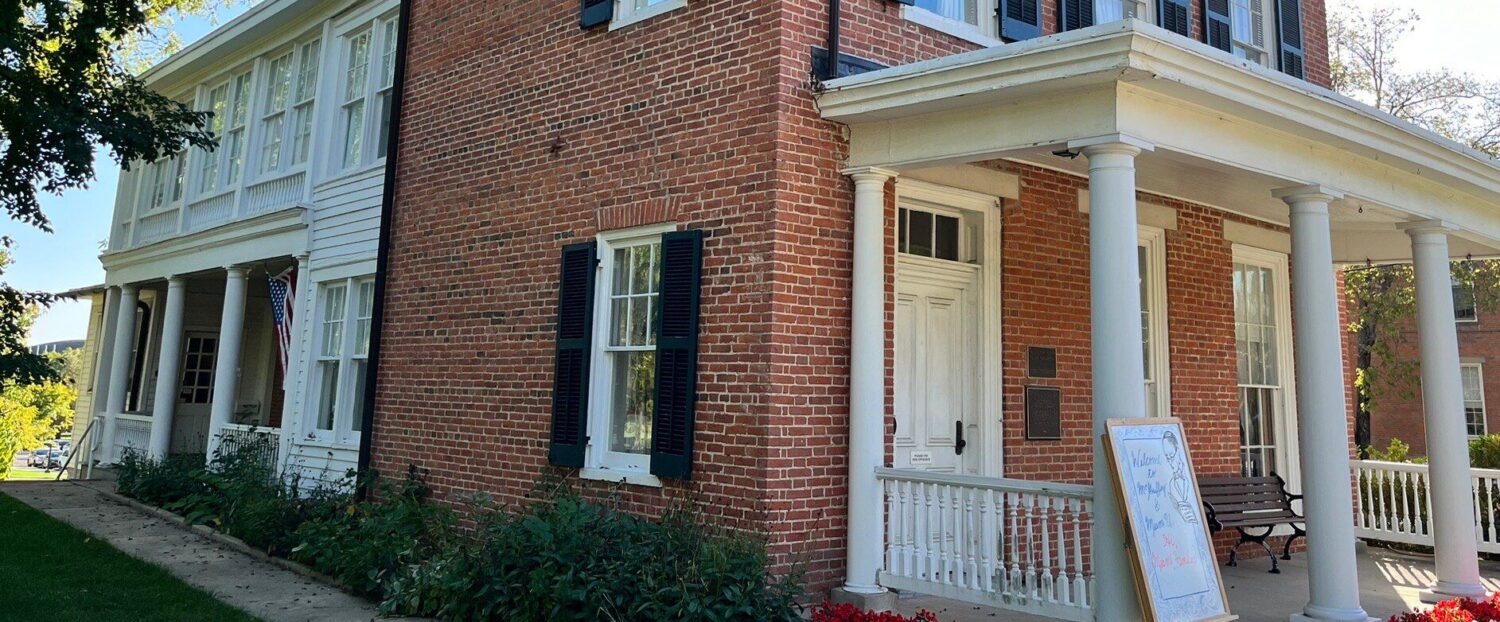
While you can go visit their graves today, you can also see a remnant of the man–his yellow-cushioned parlor chair, that is–and the house that Henrietta spent her early years in by visiting the McGuffey House.


Sources
Cornelia, Rebekah Shaw. Davidson College. Fleming H. Revell Press, 1923. https://www.seekingmyroots.com/members/files/H004964.pdf.
Dickinson College Archives. “Andrew Dousa Hepburn (1830-1921).” Last modified 2005. https://archives.dickinson.edu/people/andrew-dousa-hepburn-1830-1921.
Gillespie, Molly P. and Mark Grotjohn. “Andrew Dousa Hepburn.” In Davidson Encyclopedia. June 29, 2006. https://davidsonarchivesandspecialcollections.org/archives/encyclopedia/andrew-dousa-hepburn.
Grotjohn, Mark. “Hepburn, Andrew D. Presidential Portrait.” Davidson College Archives and Special Collections. Accessed October 18, 2024. https://davidsonarchivesandspecialcollections.org/archives/encyclopedia/andrew-d-hepburns-presidential-portrait-2.
Hepburn, Andrew Dousa. Documenting the American South. University Library, The University of North Carolina at Chapel Hill, 2005. https://docsouth.unc.edu/global/getBio.html?type=bio&id=pn0000726&name=Hepburn,%20Andrew%20Dousa.
Landsman, Danie. “The Fall of Fort Fisher: The End of Confederate Trade.” American Battlefield Trust. Accessed October 18, 2024. https://www.battlefields.org/learn/articles/fall-fort-fisher.
Miami University. “Historical Timeline.” About Miami. Accessed October 18, 2024. https://miamioh.edu/about-miami/history-traditions/timeline/old-miami/index.html.
NCpedia. “Wilmington, Fort Fisher, and the Lifeline of the Confederacy.” A North Carolina History Online Resource. Accessed October 18, 2024. https://www.ncpedia.org/anchor/wilmington-fort-fisher-and.
“Necrological Report.” The Princeton Theological Seminary Bulletin XV, no. 2 (August 1921). https://ia801508.us.archive.org/7/items/princetonsemina1521prin_1/princetonsemina1521prin_1.pdf.
Steelman, Bennett L. “Hepburn, Andrew Dousa.” In Dictionary of North Carolina Biography. Vol. 3, H-K. University of North Carolina Press, 1988. https://www.ncpedia.org/biography/hepburn-andrew-dousa.
Toothaker, Erin. “’Domestic Memory’: The Journals Correspondence and Artifacts of Henrietta McGuffey Hepburn.” Master’s thesis, Miami University, 2013. http://rave.ohiolink.edu/etdc/view?acc_num=miami1376333623.