
This website specializes in providing short selections from historical primary sources, edited and annotated for readability. Teaching from primary sources allows students to engage directly with voices from the past. It can also provide opportunities for students to think critically about whose voices are preserved in the historical record and why.
Except as otherwise indicated, these edited readings are made available under a Creative Commons BY-NC-SA license. This means that you have permission to download and copy these readings for classroom use. You can even further adapt or edit the readings as long as (a) you credit the creator(s) named at the end of each reading, and (b) you allow others to use and adapt your adaptation as freely as you’re being allowed to use and adapt this material.
This website is a work in progress. More readings are coming!
Special upload

Photo: Ramon FVelasquez, “Our Lady of Guadalupe at the Makinabang Church in Baliuag, Bulacan.” Wikimedia Commons. Used under a CC BY-SA 3.0 Unported License. Cropped from the original.

Introducing key concepts
| YEAR | TITLE | AUTHOR |
|---|---|---|
| c. 539 BCE | Religion supporting empire: The Cyrus Cylinder | Cyrus II |
| 500s BCE | Religion resisting empire: Oracles against Babylon | Isaiah (attr.); Jeremiah |
| 331-167 BCE | Religion resisting empire: The Maccabean Revolt | anonymous chronicle (1 Maccabees) |
| 2002-2006 | Is the United States an empire? Competing views | Bernard Porter; Dinesh D’Souza |
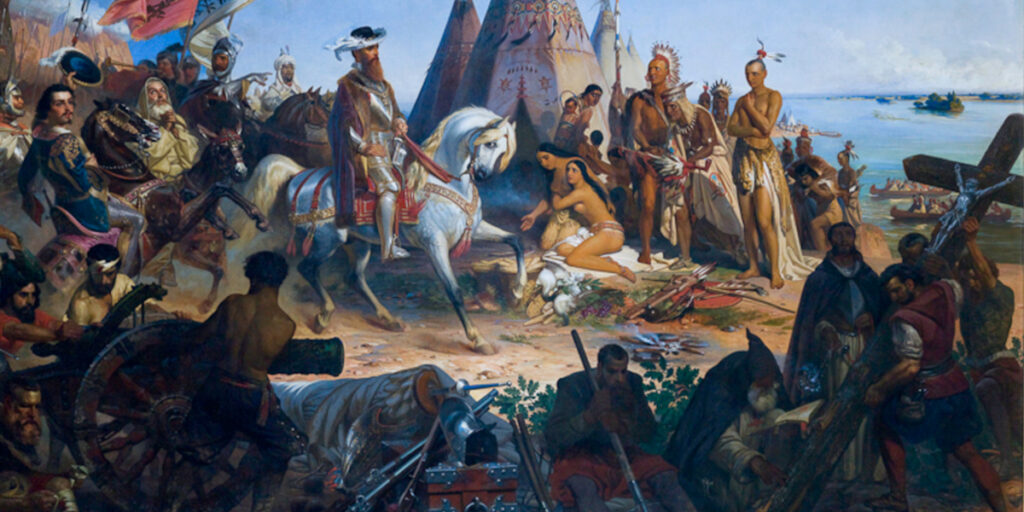
Image: William H. Powell, Discovery of the Mississippi by De Soto (1853). Wikimedia Commons. Public domain. Cropped from the original.

1400-1763: Colonial beginnings

Image: Edward Savage, The Washington Family (1789-96). National Gallery of Art. This object’s media is free and in the public domain. Cropped from the original.
1763-1830: Inaugurating the “empire of liberty”
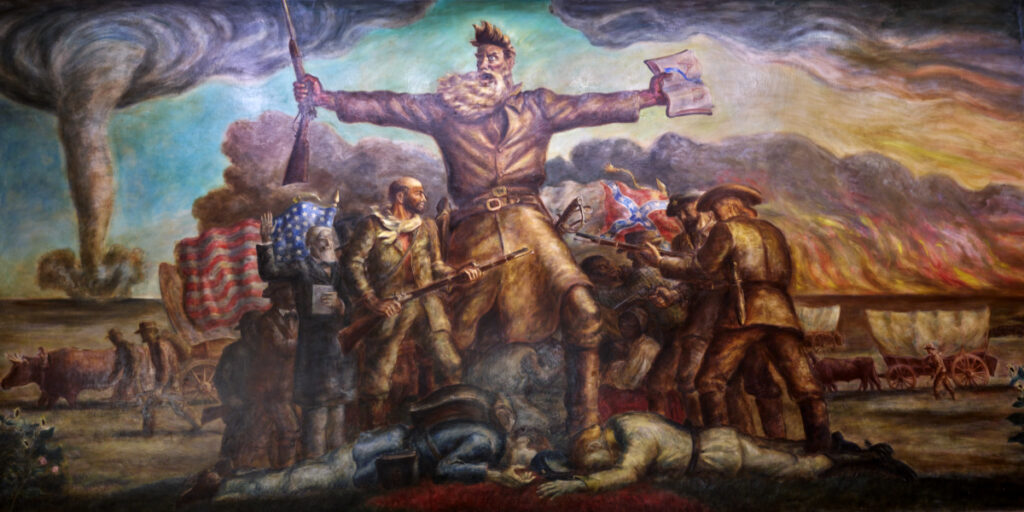
Image: John Steuart Curry, Tragic Prelude (1942). Photograph from the Carol M. Highsmith Archive, Library of Congress. No known restrictions on publication.
1830-1865: From Indian Removal to emancipation
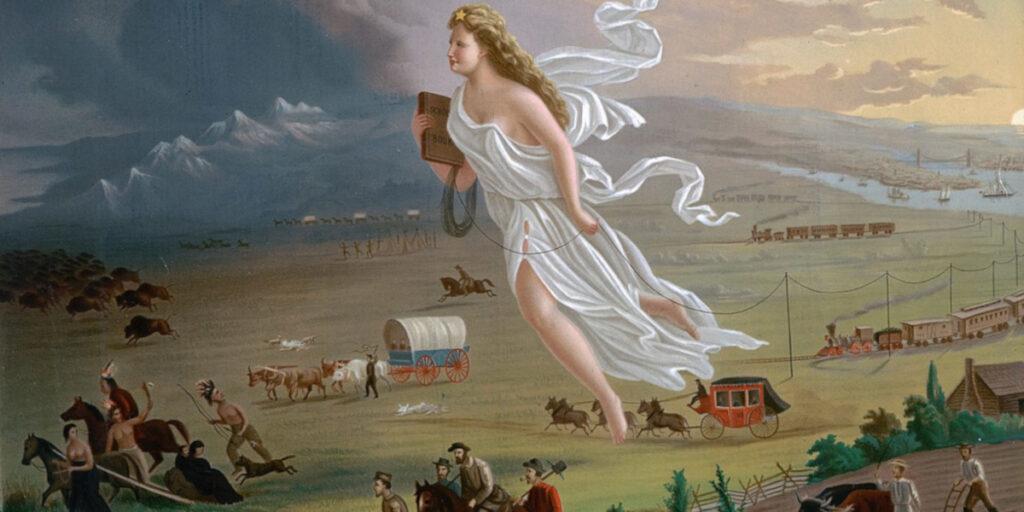
Image: John Gast, American Progress (1872), remastered color. Wikimedia Commons. Public domain. Cropped and slightly rotated.
FXD.jpg)
1865-1914: The era of the “new imperialism”
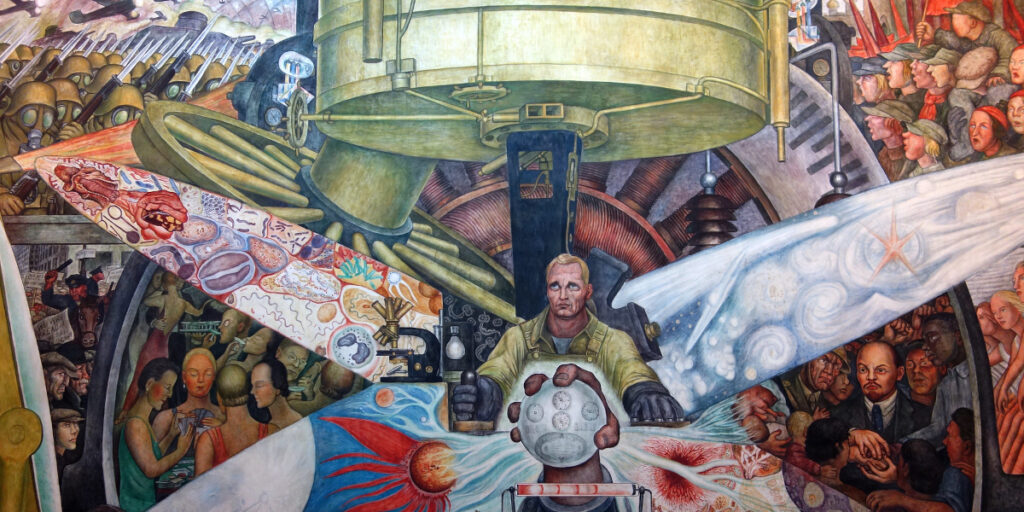
Image: Diego Rivera, Man, Controller of the Universe (1934). Photograph by Flickr user Steven Zucker. Used under a CC BY-NC-SA 2.0 Generic License. Cropped from the original.
1914-1945: Birth of a superpower
| YEAR | TITLE | AUTHOR |
|---|---|---|
| 1915 | “The New Internationalism” | Charles S. Macfarland |
| 1916 | Ku Klux Klan initiation rite | KKK handbook |
| 1917 | “God’s Call to America” | Randolph H. McKim |
| 1917 | A Statement to My People on the Eve of War | John Haynes Holmes |
| 1918 | The Band of Gideon and Other Lyrics | Joseph Seamon Cotter Jr. |
| 1918 | The Twentieth-Century Crusade | Lyman Abbott |
| 1919 | The New Opportunity of the Church | Robert E. Speer |
| 1919 | Poems in The Liberator | Claude McKay |
| 1921 | Universal Negro Catechism | George Alexander McGuire |
| 1927 | The Holy Koran of the Moorish Science Temple of America | Noble Drew Ali |
© 2021-2026 by John-Charles Duffy. Except as otherwise noted, the contents of this website are made available under the Creative Commons Attribution–NonCommerical–ShareAlike 4.0 International License.
Contact: [email protected]