

By Mikayla Deiotte
During my Earth Expeditions course in India with Project Dragonfly, one theme that surfaced repeatedly: conservation science isn’t just about data or research, it’s about connection.
Being on the ground in the Western Ghats made me realize how deeply tied people are to the land they inhabit, and how that intimate relationship shapes the way conservation actually happens. Visiting temples surrounded by monkeys, vibrant birds, and lush greenery showed me a living example of what occurs when nature and culture grow together. These weren’t just sacred spaces for people; they were thriving habitats for countless species.

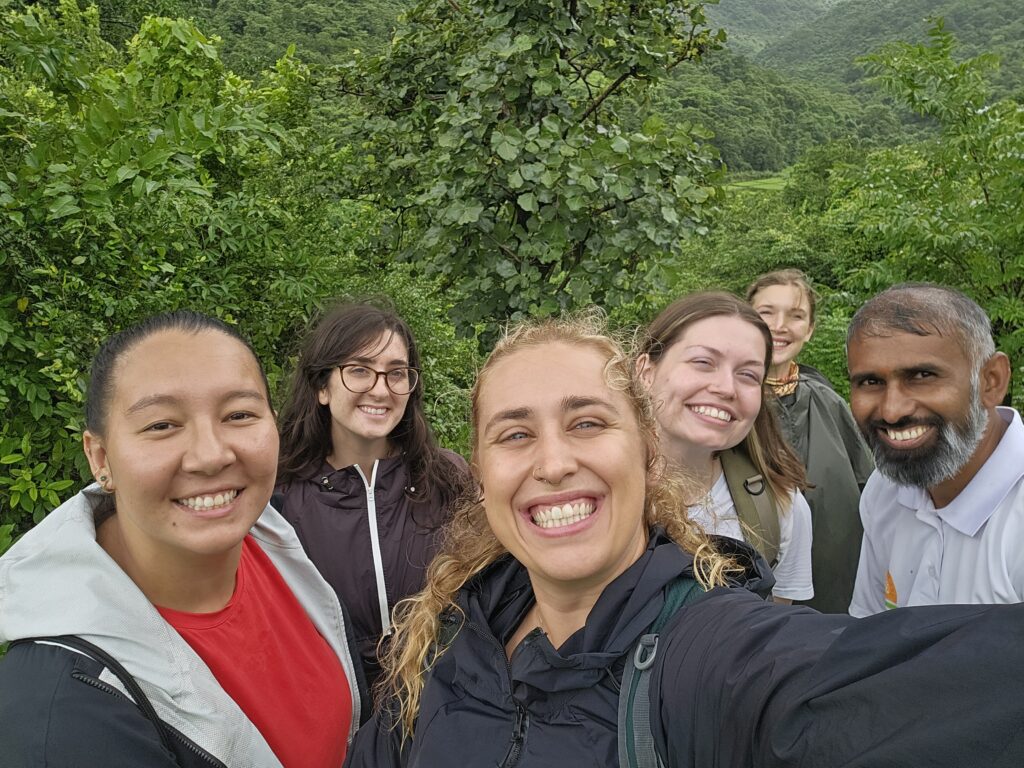
Caption: Mikayla (center) and her Earth Expeditions cohort finding community amidst the lush greenery of India.
Conservation Woven into Daily Life
Back home, conservation can sometimes feel like something “over there”—separate from our daily routines. In India, it felt woven into the very fabric of existence.
Of Project Dragonfly’s five core focus areas, three stood out to me with particular clarity: community engagement, environmental stewardship, and global/local understanding. My conversations with the Applied Environmental Research Foundation (AERF) were transformative. They spoke about protecting native species and traditional ecological practices in a way that demonstrated how conservation can be beautifully and effectively integrated into the day-to-day.
“Real conservation is about relationships between people, places, and the creatures we share space with.”

Caption: Connecting with local community members provided firsthand insight into the traditional ecological practices of the Western Ghats.
Bringing the Global Story to the Classroom
As a teacher, I found myself constantly brainstorming how to translate these “aha” moments for my students. While I already teach them about local flora and fauna, this trip sparked a desire to help them see the bigger picture. Whether we are planting native flowers, reducing waste, or simply paying attention to the life in our own backyards, these small acts are chapters in a much larger global story.
Beyond the pedagogy, there were sensory moments that I will carry forever:
- Ancient temples glowing in the soft light of sunrise.
- The rhythmic echo of birdsong across the valley.
- The profound peace of sitting atop a mountain after a grueling hike.
That moment of meditation in nature was grounding in a way I didn’t expect. It was a vital reminder to slow down—a difficult task when caught in the constant motion of teaching and everyday life.

Caption: Reflecting on the “threads of care” that bind us all while overlooking the misty mountains.
Growth Beyond the Comfort Zone
Admittedly, being outside of my comfort zone was both uncomfortable and freeing. In my classroom, I am used to being the one in control, the one who knows what comes next. In India, I had to rely on others, remain flexible, and embrace learning through experience rather than rigid structure.
“Conservation, like learning, isn’t about perfection; it’s about being open, curious, and connected.”
I left India with a deeper understanding: growth happens when we stop trying to control every outcome.
A Poem from the Field
Under temple shadows and banyan trees,
I learned that stillness can speak.
Mountaintop air carried a lesson
Slow down, breathe, seek.
The world feels smaller now, yet wide,
Threads of care binding near and far.
From India’s soil to my students’ hands,
We all share the same bright star.
Author Biography:
My name is Mikayla Deiotte and I live in Canton, Ohio. I am a high school Biology and Environmental Science teacher at Hoover High School. My mentor teacher was the one who told me about Project Dragonfly, and once I started investigating the program, I knew I had to be a part of it. The values and goals of Project Dragonfly align with my own and what I strive to accomplish in my classroom.