By Austin Pawar
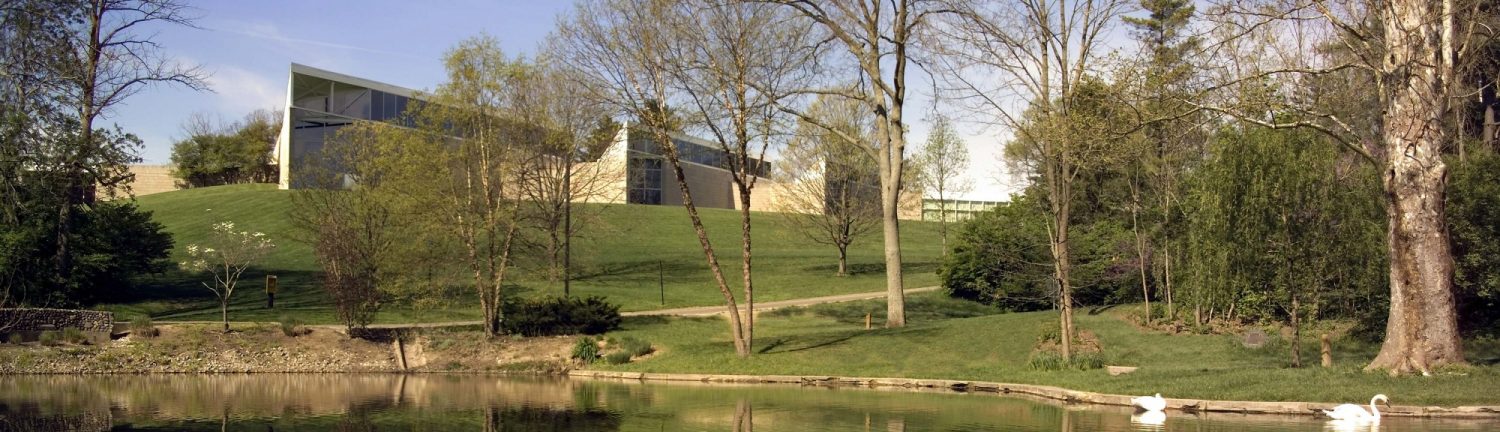
This spring I had the privilege of interning by conducting research on one of its founders, Miami Alum Walter I. Farmer (1935). This project involved intensive archival research. I searched through museum files looking for important letters and documents and digitized a document, and used Artificial Intelligence to create a timeline. Overall, I learned valuable skills that can be applied in a future career, as I aspire to be a historian. In addition to these skills, I learned how important Walter Farmer was, not only to the Art Museum’s creation, but also to the ethics of art conservation.
Service in World War II
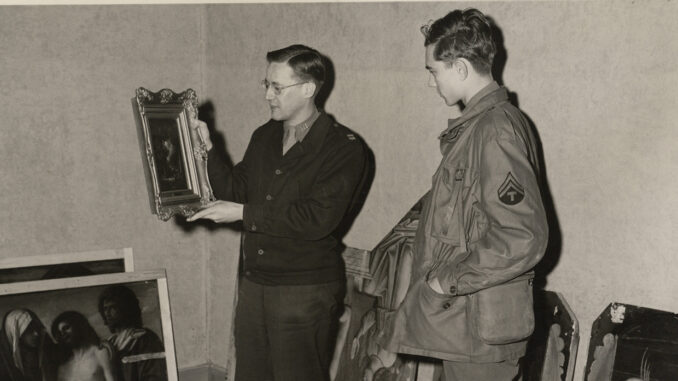
When the United States entered World War II, Farmer was called up to service multiple times, but was denied entry due to poor eyesight. In 1942, however, by chance, he did not receive an eye exam and was accepted into the Army Medical Corps. Realizing his exceptional leadership ability, Farmer’s first unit sent him to Officer Candidate School for the Army Corps of Engineers. After graduating in 1943 as a second lieutenant, he was assigned to the 373rd Engineers and shipped off to England. Due to a car accident, Farmer would not participate in the D-Day landings, but later rejoined his unit as they repaired bridges as the Allies advanced through Europe.
By June 1945, the war in Europe had ended, and the 373rd was to return home. Farmer, who had been promoted to the rank of Captain, applied for a position within the Army’s Monuments, Fine Arts, and Archives program (MFAA )and was reassigned as director of the Collecting Point at the Wiesbaden State Museum in Germany, a center for artwork recovered by the Allies. Farmer was in charge of cataloging, restoring, and returning thousands of recovered artworks.
In November 1945, Farmer received a telegram from the 7th Army headquarters, which ordered that 202 German artworks were to be shipped to the U.S.. Farmer saw this order as complete hypocrisy since the U.S. was taking German artwork out of Germany while simultaneously prosecuting Germans for the artwork they had stolen during the war. Outraged, Farmer requested that another MFAA officer draft the Wiesbaden Manifesto, which articulated his criticisms. In protest, 31 MFAA officers signed the document and sent it to Major Bancel LaFarge at MFAA headquarters. Due to the fear of insubordination for officers under him, Major LaFarge hid the document away. The German artworks were shipped to the U.S. and went on tour. Subsequently, MFAA lieutenant Charles Kuhn published the Wiesbaden Manifesto, which caused public outrage and led to a call to return the artworks to Germany. Eventually, the U.S. Government returned the artworks to Germany in 1949. In 1997, Farmer was awarded the Special Service Cross by the German Government for his contribution to the return of the “202.”
The Walter I. Farmer Collection at RCCAM
Although Farmer had been collecting since he was a child, it was not until his time in Germany that he started to collect more seriously. While at Wiesbaden, Farmer supported local artists by buying their artwork.
By the 1960s, due to the success of his own company, Farmer’s lifestyle allowed him to travel and acquire objects that were eventually displayed at RCCAM. By the time of its founding in 1978, Farmer had donated hundreds of artifacts, including those from ancient Greece and Rome, Mesopotamia, Africa, and early America.
While conducting my research, I wondered if RCCAM had objects that Farmer acquired during his time in Wiesbaden. Farmer did not provide the Art Museum with copies of the receipts indicating where and from whom he had acquired his objects. Because of this, I could not connect any of the objects to his service.
Towards the end of my internship, however, my supervisor, Dr. Jack Green, stumbled upon an archival document. that contained a list of Farmer’s donated objects as well as information on how and where he had acquired them. I came across a record of a Greco-Roman sculpture entitled “Head of Woman.” The document indicated that Farmer purchased it in Germany in 1946, which means that he acquired it around the time he was at Wiesbaden. This object is currently on display as part of RCCAM’s permanent collection. It is fascinating that RCCAM currently houses an object from such an important period in the history of art restitution.

Head of a goddess, 1st century BCE, Marble. Findspot unknown. Gift of Walter I. Farmer 1978, purchased in Germany, 1946. 6 ¼ x 4 ¼ x 5 ⅜ inches. 1978.S.2.2.
Farmer and the Art Museum
Walter Farmer’s collection was a driving force in the creation of the Art Museum. As a result of his time as a student at Miami University, Farmer became close friends with Orpha Webster, who had been one of his professors. Webster dreamed about creating an art museum at Miami University. It was Farmer’s collection that made that dream a reality. In 1966, Webster first approached Farmer with the idea. The promise of Farmer’s collections became a reason for the Art Museum to be created. This sentiment was also shared by Sterling Cook, one of its first curators. In one letter, he stated, “I do not hesitate to say that the real motivation behind this center/museum, and which set the wheels of University Administration in motion at all, was the two gifts of Walter Farmer and his bequest.”
In 1968, Webster introduced Farmer to John E. Dolibois, then Vice President of Alumni Affairs at Miami University. Together, Farmer and Webster would influence the purpose and design of the museum while Dolibois managed the financial side of the project. On September 6th of the same year, Farmer sent a letter to Dolibois outlining the conditions of his bequest to the museum. Farmer stated that the museum must be of a contemporary design and stated that the building must not only serve as a museum, but as an educational center that students can use to advance their skills and knowledge.
Webster and Dolibois tried to make advancements with the creation of the museum, but there was little interest. To combat this issue, Farmer hosted dinner parties to show off his collection and increase conversation about the Art Museum. It was at one of these parties that Farmer announced his support for the building of the Museum. In an oral history interview conducted in April 2025, retired faculty member Robert Wolfe recalled Farmer’s party as “the most extravagant dinner I have ever been to.”

The Greco-Roman “Head of a Woman” next to a selection of other objects donated by Walter Farmer on view in the Orpha Webster Gallery.
Conclusion
Walter Farmer was not only a key figure in art preservation and restitution during wartime and post-conflict settings but also played a direct role in the creation and vision of the Art Museum at Miami University. The Wiesbaden manifesto outlined the double standard in which the United States, like the Nazis, was also removing important cultural pieces from their place of origin. This forced the United States to return the “202” to Germany and set a new standard for cultural preservation. As for the Art Museum at Miami University, Farmer is equally influential. His collection and dinner parties sparked interest in the creation of the museum. Additionally, Farmer influenced the architectural design and function of this institution.
This internship taught me valuable skills that I will use in my future intended career. I gained valuable archival experience, learning how to digitize and organize primary sources and then use those sources to fill historical gaps. The biggest takeaway I have from my research is that this experience would not have been possible without the contribution and vision of Walter Farmer, and I am grateful that RCCAM is fulfilling Walter’s vision of a learning center at which interns like myself can gain valuable experience.

Austin Pawar is a History Major and Environmental Science co-Major. Austin is also in Army ROTC at Miami University and plans to commission as a second lieutenant after he graduates. In Spring 2025, Austin worked as a History Project intern at RCCAM where he assembled, reviewed, and digitized primary and secondary sources related to Walter I. Farmer.
Further Reading
Walter I. Farmer, 2000. The Safekeepers: a Memoir of the Arts at the End of World War II. Berlin: Walter de Gruyter.
Peter Jonathan Bell and Kristi A. Nelson (eds), 2020. The Berlin Masterpieces in America: Paintings, Politics and the Monuments Men. London: D. Giles Ltd.
Walter Havighurst, 1982. The Dolibois Years, 1938-1981: To these things you must return. Oxford: Miami University Alumni Association.
SUPPORT US
Please visit the Art Museum Giving Page and consider becoming a sustaining member or making a donation to support RCCAM’s exhibitions, programs, and collections.
FOLLOW US ONLINE
Access all of our online social media accounts here.