
By Grace Tran, Art Bridges Fellow, Columbus Museum of Art
I came to the Richard and Carole Cocks Art Museum (RCCAM) for the first time earlier this spring to share about Louise Nevelson: Dawn to Dusk, a traveling exhibition currently on view at the Columbus Museum of Art (CMA). This timely moment with both our museums exhibiting works by Nevelson echoes a local history; only a few decades ago, the artist frequented Ohio as she showed in numerous solo exhibitions at Pace/Columbus, a no longer extant satellite location of the now international Pace Gallery. Close friends with both the Pace Gallery and Pace/Columbus founders, Nevelson became known for coming to town for every opening and, during one such trip in 1977, even gave a guest lecture at the Columbus Gallery of Fine Arts (now CMA). These were already incredible histories that I was excited to share with Ohioans, but after receiving archival materials from RCCAM in preparation for my talk, I began to learn about a special connection specific to Oxford and Miami University.
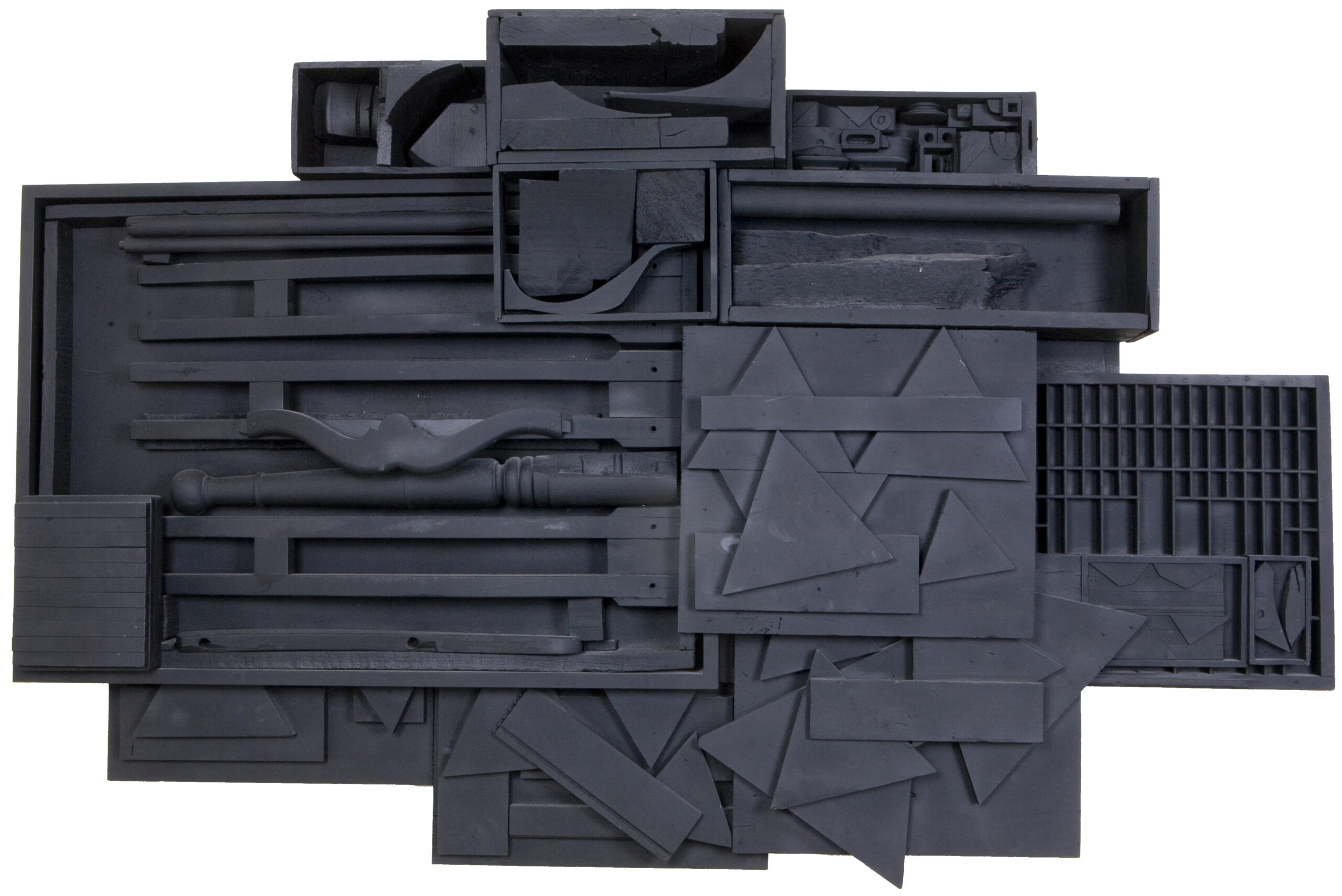
On February 12, 1966, the Western College for Women bestowed an honorary Doctorate in Fine Arts on American sculptor Louise Nevelson, kicking off the first of many honorary degrees that higher education institutions would come to award the artist with over the next two decades. In 1980, the Western College Alumnae Association continued to underscore the university’s recognition of Nevelson’s significance to American art by acquiring and gifting a wooden sculpture titled Rain Garden Zag IX (1978) to what is now RCCAM. Celebrating Western College’s early awareness of Nevelson’s influence as well as fulfilling a commitment to furthering the breadth and prestige of the Art Museum, the Alumnae Association brought an incredibly exciting work to the campus that continues to capture the imagination of all those who encounter it today.

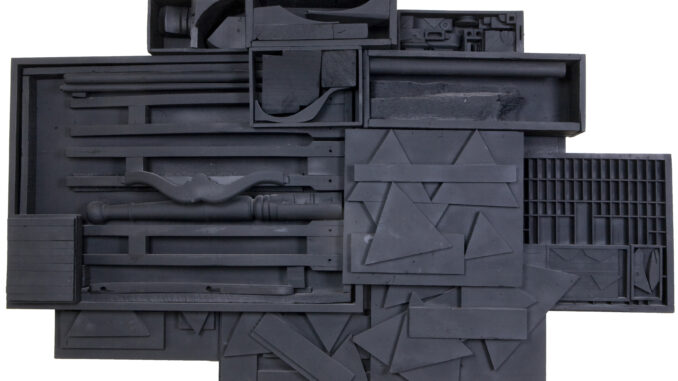
Rain Garden Zag IX is comprised of found and fabricated wood pieces painted matte black. Though Nevelson did not become most known for her wood sculptures until the late 1950s, she began making and exhibiting wood pieces as early as the 1940s. However, disappointment or frustration over lack of sales and a quickly dwindling amount of storage space led her to destroy approximately 200 early works. When she returned to working in wood about a decade later, she began creating monochromatic works in that signature black (and later, white, then gold).
Though Nevelson thought of her art as complete entities of their own, not just combinations of color, material, and medium, she simultaneously felt that the individual wood pieces had lives of their own. When she began using scrap wood collected from the streets, she sympathized with their perception as discarded material. To her, their life cycles had not yet ended—they were soon to be reincarnated within her practice.
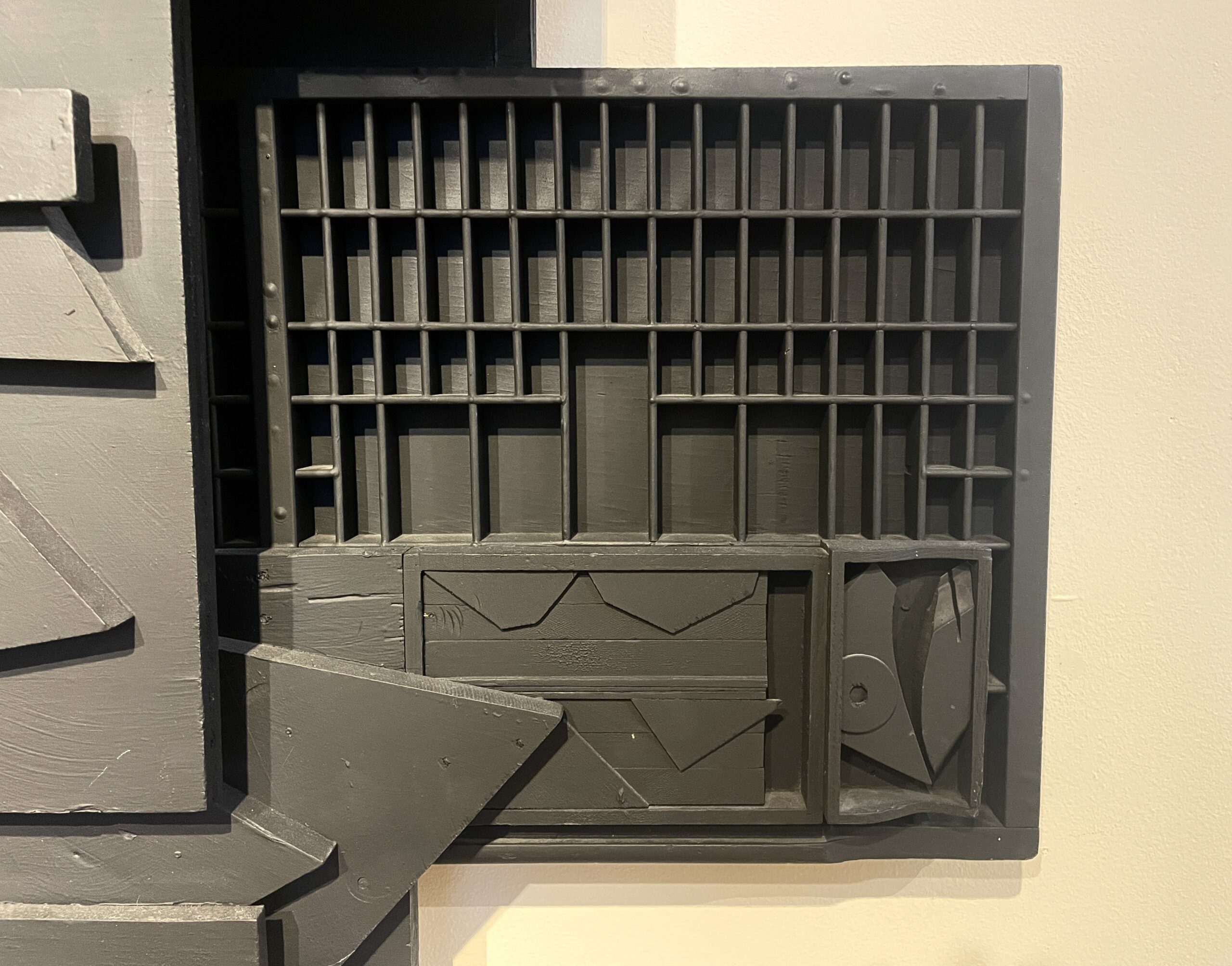
A guest of my gallery talk, Dick Sollmann, who had had a long career in press media, astutely observed that one component of Rain Garden Zag IX was originally a letterpress tray repurposed into sculptural material. Nevelson indeed collected visually interesting objects such as these printer’s trays, carefully curating her sculptures to be dynamic and varied in their composition. I had not recognized the letterpress tray and the guest’s comment was not only informative but moving as well; that one could come across a work of art and spot familiar objects with which they felt some sort of connection was a beautiful and unifying thought.
Rain Garden Zag IX is from a later period of Nevelson’s career, exemplified by her burgeoning impulse to expand out of the four sides of her perhaps most well-known wall sculptures. Breaking out into still rectilinear but now stepped shapes, these works, like all those that bear the word “zag” in their title, are a little irregular. Some contain boxes staggered in points of attachment to hang together like a wreath and others explore triangular and hexagonal shapes. Networks and patterns continue to be a central focus.
The sculpture was first shown at the Richard Gray Gallery in Chicago in 1978 alongside other works from the Rain Garden Zag, Rain Garden, and Rain Garden Cryptic series. Contrasting with the appearance of the other series, the Rain Garden Cryptic works were small, hinged boxes which could open and close, revealing a shrouded interior amidst the frenzied geometries of their external faces. A sense of privacy pervades much of Nevelson’s sculptures, which hide things in the compartments, shadows, and unseen depths of her works.

I was delighted when the small, unassuming rectangular shape on the lower left corner of Rain Garden Zag IX was revealed to me by RCCAM’s curatorial team to be a hinged box affixed to the face of the sculpture. With its exterior plainly adorned with thin slats of wood, my eye had originally brushed over this component for some of the more assumedly dynamic elements like the jaunty cluster of triangles. The box was carefully opened by curator Jason Shaiman (an act only to be done by the museum’s trained art handlers), revealing smoothly polished shapes packed into its body. Where I was looking for hidden mysteries within the crevices of the visible boxes—trying to peek as best I could behind some of the joined wood fixtures—Nevelson had cleverly placed a hiding spot within plain sight, letting all those who knew of it enjoy that shared secret.


My excitement was doubled in realizing yet another connection between CMA and RCCAM. CMA’s presentation of Dawn to Dusk includes a permanent collection work titled Black Mirror I, a wall-hanging sculpture which featured the same type of hinged door as Rain Garden Zag IX. Vacant in comparison to her most densely packed works, Black Mirror I offers, to me, a subtle and serene moment for contemplation. In the installation images of the work seen above, a careful balance of texture, shape, and shadow emerges. The spaces in between don’t feel empty, though—rather, the absence of object itself becomes almost tangible. Nevelson, who proclaimed herself an architect of many sorts, understood the ideas of the interior and exterior in a multiplicitous sense. She not only built physical structures but also constructed intimacies, allowing her to navigate the complexities of her subconscious in her own way, and on her own time.

Louise Nevelson: Dawn to Dusk continues to be on view at the Columbus Museum of Art through August 24th, 2025. Featuring more than fifty works, the exhibition traces Nevelson’s artistic evolution, from her early figurative paintings to her iconic abstract wood constructions, collages, and unique handcrafted jewelry. Originally organized by the Farnsworth Art Museum in Rockland, Maine, Dawn to Dusk reflects the full arc of Nevelson’s career and her enduring legacy as a pioneering sculptor of international renown.
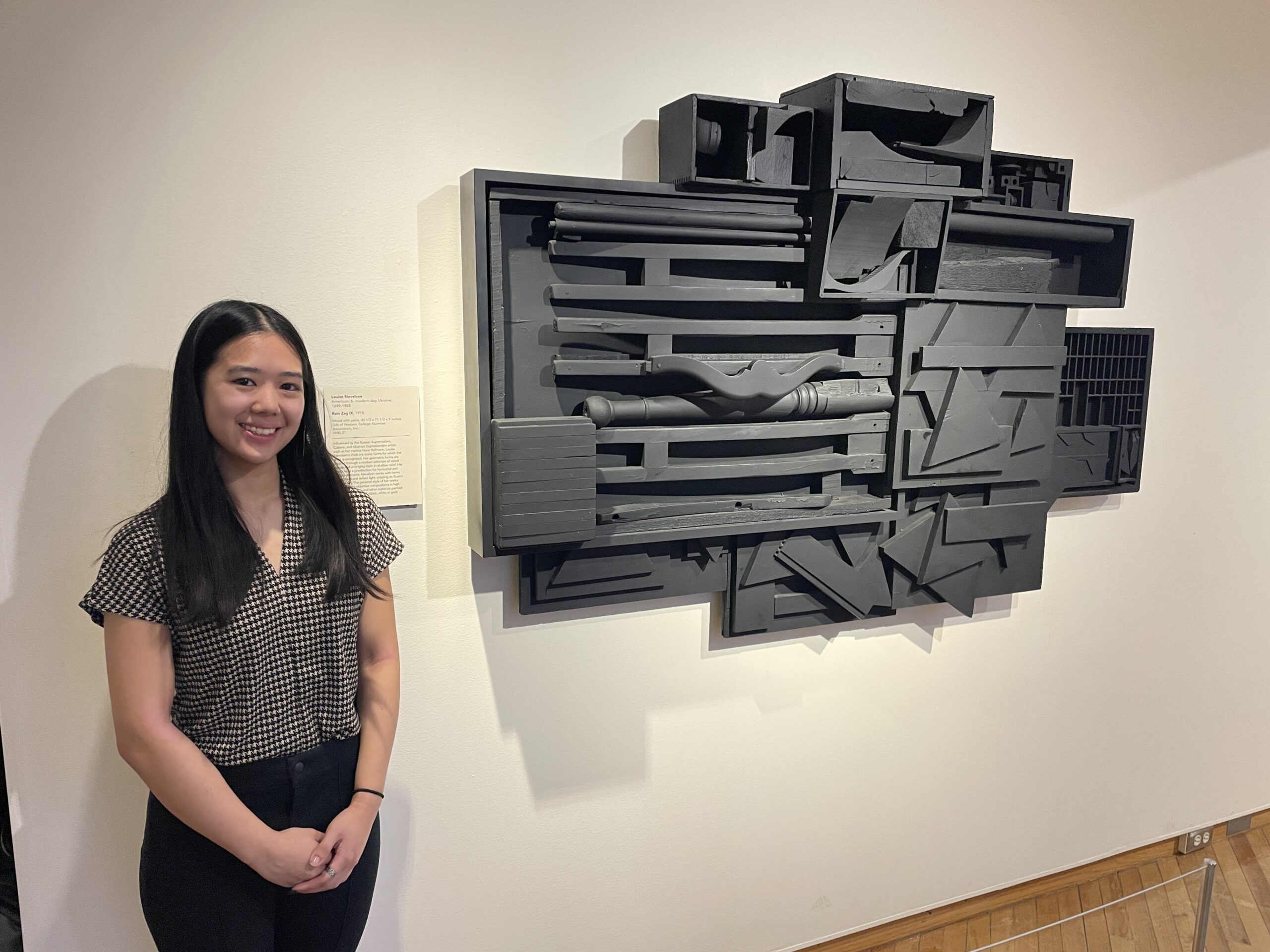
Grace Tran is the inaugural Art Bridges Fellow at the Columbus Museum of Art (CMA), where she works in the Collections and Exhibitions department. She received her MA in Art History from The Pennsylvania State University and her BA in Art History and Museum Studies from Cornell University. She has held previous curatorial and registration positions at the Herbert F. Johnson Museum of Art, Philadelphia Museum of Art, and Palmer Museum of Art.
SUPPORT US
Please visit the Art Museum Giving Page and consider becoming a sustaining member or making a donation to support RCCAM’s exhibitions, programs, and collections.
FOLLOW US ONLINE
Access all of our online social media accounts here.