
SIGHT Quarterly Update: Research Submissions, VR Progress, and IoT Instrumentation (Oct 1 – Dec 31, 2025)
Summary
This quarter, the SIGHT team advanced two NAMRC research submissions, expanded our webVR training environment, and installed IoT sensing to capture performance data across Industry 2.0–4.0 equipment.
Over the past quarter, the SIGHT team (Safety Immersive Gamified Hazard Training) advanced our work across research, immersive training development, and shop-floor sensing. This post highlights four milestones from Oct 1 to Dec 31, 2025.
We are grateful to the Ohio BWC/WISC team for their funding and continued support of SIGHT.
(1) NAMRC Paper Submission: Safety 4.0, Computer Vision, and Collaborative Digital Twins
Our first NAMRC submission focuses on how safety can evolve alongside smart manufacturing. While production systems are increasingly connected and adaptive, safety practices are often still reactive and rule-based. In this paper, we propose a collaborative digital twin approach that integrates complementary “views” of the manufacturing system to support safety decision-making and training. The goal is to enable more context-aware safety capabilities that can detect and interpret safety-relevant events and support timely, actionable responses, while also connecting naturally to immersive training experiences.
(2) NAMRC Paper Submission (Public on arXiv): Multimodal Safety Chatbot and RAG Evaluation
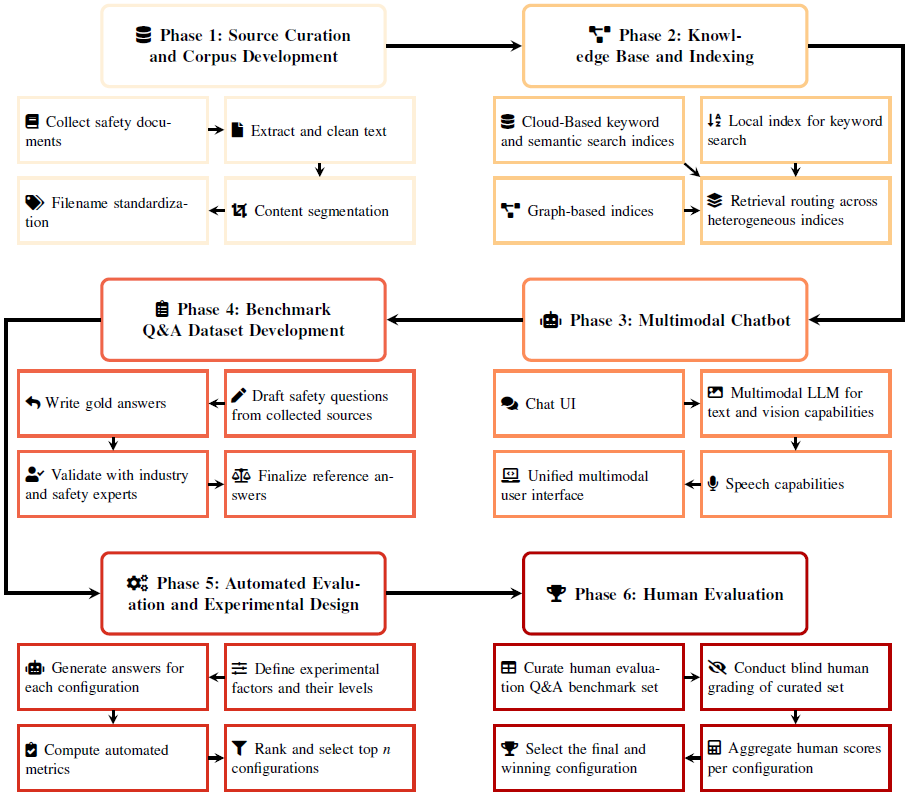
Ensuring worker safety remains a critical challenge in modern manufacturing, and Industry 5.0 motivates more human-centered approaches to safety training and operational support. Using a design science research methodology, we identify three practical requirements for next-generation safety training systems: high accuracy, low latency, and low cost. We introduce a multimodal chatbot powered by large language models that uses retrieval-augmented generation (RAG) to ground responses in curated regulatory and technical documentation.
To evaluate the solution, we developed a domain-specific benchmark of expert-validated question and answer pairs across three representative machines: a Bridgeport manual mill, a Haas TL-1 CNC lathe, and a Universal Robots UR5e collaborative robot. We tested 24 RAG configurations using a full-factorial design and assessed them with automated measures of correctness, latency, and cost. The top two configurations were then evaluated by ten industry experts and academic researchers. The top configuration (selected for deployment) achieved 86.66% accuracy, 10.04 seconds average latency, and $0.005 average cost per query. For more details, please see the paper on ArXiv.
(3) XR Development: Significant Progress on the VR Virtual Environment
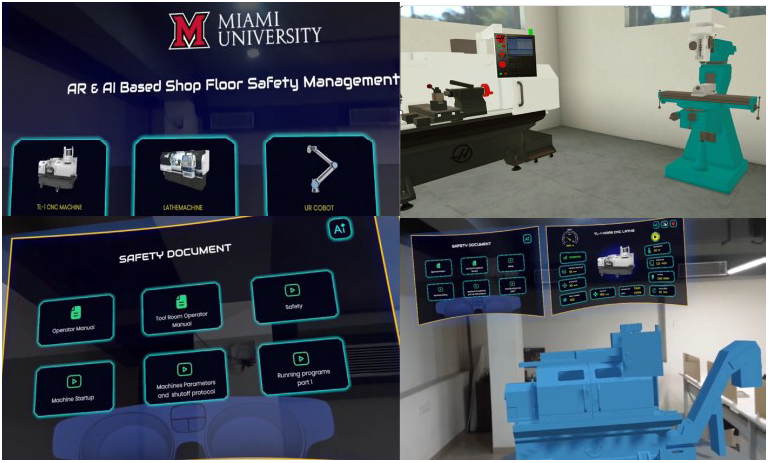
This quarter we made significant progress on the virtual environment supporting SIGHT’s VR training modules. One early deliverable is a preliminary webVR experience (developed with MeetKai Inc.) demonstrating a starter training module for a manual milling machine. This is one of three manufacturing equipment platforms we are developing operational and occupational safety training for, spanning Industry 2.0 through Industry 4.0.
At this stage, our focus is on validating training flow, interaction design, and environment fidelity, then iterating quickly based on expert feedback.
(4) Instrumentation Milestone: IoT Sensors and Data Capture Across Industry 2.0 to 4.0 Equipment
A major technical milestone this quarter was installing IoT sensors on our milling machine, enabling us to start extracting and storing machine performance data on our local server. We can now collect machine performance data across three manufacturing “generations” in our SIGHT testbed:
- Industry 2.0: traditional manual milling machine
- Industry 3.0: CNC lathe
- Industry 4.0: collaborative robot (cobot)
For the milling platform specifically, we now have a vibration sensor installed, along with an infrared thermal sensor monitoring the milling area. These streams provide a foundation for connecting operational signals to safety-relevant events and, ultimately, to immersive training scenarios and safety analytics.
Looking Ahead
Next quarter, we will continue expanding the VR modules, refining the virtual environment based on expert input, and deepening how sensor data can inform both safety analytics and training personalization across our three equipment platforms.