
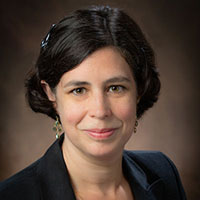
 In this interview, Dr. Hutton discusses her past experiences getting into her current field at Miami University and her work as the Director of the Howe Writing Center.
How did you get into the rhetoric and writing field? What experiences led you to seek a career in teaching and in writing?
“I received my MFA in Creative Writing at University of Michigan, and I found I really enjoyed teaching through the job I had there as a graduate student, teaching creative writing and college writing. Once I graduated from my MFA, I was lucky enough to get hired as a lecturer for the English Department, teaching first-year writing courses.
“One to two years later, I transitioned to also working at the writing center at U of M. That center has a peer tutoring arm, but they also have full-time writing center faculty who split their time between writing center work—holding consulting hours—and teaching writing courses. For 12 years, I spent 10 hours a week in what we called “writing workshop” and what the Howe Writing Center calls consulting. And in addition to teaching first year and advanced writing, I also taught introductory literature courses, creative writing, and arts-based courses for a variety of living-learning communities on campus. I also taught the training course for the Peer Tutors a number of times. This gave me a real range of teaching experience, since I was working with a broad array of writing and writing center related courses, and working with students at a variety of levels. It was very practical entry into the field of writing studies and writing center studies.
“I was genuinely happy with the career I had as a lecturer there, and with my community of fellow teachers and writers, but after some time, I realized that I was hungry for more professional development, more theoretical knowledge of the field, and more research opportunities—hence my applying for Michigan’s PhD program in English and Education. I went back for my PhD knowing I wanted to continue pursuing writing studies, composition, and rhetoric, since it was a field I was so experienced in. But I also keenly felt that this wasn’t the field I had studied as an undergrad—in college, I studied literature and creative writing—so I also knew that all the practical experience I’d developed was missing a certain intellectual foundation, which I was eager to gain.”
Any advice you would give to undergraduate students in the PW program right now?
“What I’ve learned through both my graduate experiences and my writing center work is that writing does not and cannot happen, or develop very happily, in a vacuum; instead, writing and a strong sense of a writerly self thrives in the context of the subjects and materials and places and people that feed you and that you are passionate about. Writing, whether creative or academic or professional, is for me an activity that expresses or enacts some kind of intervention—some need to join and have a voice in an ongoing conversation, and to put your own specific stamp on existing ideas or genres. I would encourage young writers, especially those delving deeply into writing studies and rhetoric, to think about their acts of writing as essentially participatory—a way of engaging with historical and current norms, and as a way of adding to these norms some new spin or nuance, some new application or definition, that can push others’, and one’s own, thinking forward. “