
By Kylee Lam | MAT (Biology) GFP | Class of 2022
Education Abroad Program: Earth Expeditions Belize 3, Summer 2021
Prize Winner
Outside the mouth of a large cave, in the tangles of an even larger jungle, hung a troop of spider monkeys. I craned my head upwards awkwardly to view them. Their long lanky bodies walked easily through the canopy of these giant broad leaf trees. I couldn’t take pictures any more because my phone’s battery was dead. It was nice because I was awarded the chance to just focus on my surroundings instead of worrying about getting the best shots. Plus, Hayley’s camera was better anyways.

It was the second time we had seen wild monkeys, not the ones at the zoo. I instantly felt kind of bad because it was clear we were on their land. One monkey, a young male, started shaking the branches and sticking his tongue out at us. I don’t think he wanted us there. This made me wonder how he saw us. We were invaders, disrupting breakfast, making them move, making him change his routine.
A few things on this incredible trip had gotten me thinking about my impact in this beautiful country. A few mistakes I made allowed me to realize the conflict of just being there. Was my presence overall helpful or harmful? It’s tricky business invading an area on the premise of education and conservation meanwhile doing your best not to leave too big of a footprint.
At first I wasn’t sure why it was so bad to take a photo in front of some super cute wild black howler monkeys. We weren’t hurting them physically, holding them, or disturbing their habitat. They didn’t even seem to notice we were there. I loved watching them hang around the branches, climb up and down, swing from vines, and traverse the corridor’s mango trees. But on our walk back through the rainforest with Robert, I realized why. It was about the image and what the image means. Taking a picture with your face in the foreground and the monkeys in the background portrays the idea that you see the monkeys as nothing more than something to make your picture cuter. It makes them seem like a thing and not as a species that deserves equal respect and admiration. Beyond that, if other people see that image, it might fuel them to get similar photos but in not so good ways. The black howler monkeys need to be the only subject of the photos!
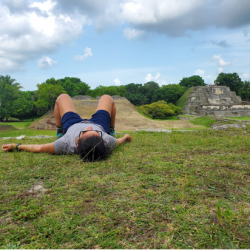
Photographs with wild animals were part of the game at the Mayan ruins called Altun Ha. As I stepped off the bus into the blazing heat, caffeine-deprived and wildly exhausted, I made my way over to a man with a very large snake. The snake was beautiful, patterned and cool to the touch. But it didn’t take me long to realize this man did not have the best intentions for snakes and conserving Belizean wildlife. Again, I reflected. I wondered if my presence on this trip was encouraging men like him to go out and capture wild snakes. I wondered if we were unintentionally driving an entire business aimed at manipulating tourists. Not paying ten bucks to get a photo with the snake was a good step and instead supporting the small sustainable farm called a milpa and the conservation-minded tour guides like Peter, was another.
As I trekked carefully away from the spider monkeys and into the caves, I thought this must be the best we can do. Not be too much of a physical presence and do the best we can to learn about the delicate relationships between animals and their environment. Listening to Runaway Creek’s presentation about their research initiatives, will help them continue their efforts and support the protection of the spider monkeys. Promoting conservation-minded travel helps to financially support these programs and also reduces impact by tourists.
The monkey sees you
Traveling through his forest
Step carefully by