
Standard balance sheets show where a business has been, but direct digital traffic signals where its revenue is heading quarters in advance.
When e-commerce pioneers like Amazon and eBay emerged in the 1990s, financial markets faced new challenges. Traditional accounting, built for brick-and-mortar factories and physical inventory, struggled to capture the value created by software-driven businesses. The dot-com boom and crash highlighted the limitations of relying solely on historical accounting records to understand rapidly changing consumer demand.
For accounting and finance professionals, historical revenue reflects what has already happened. In contrast, online customer traffic leaves a real-time digital trace of user interest long before cash flows hit the income statement. A study published in the Journal of Accounting and Public Policy by accountancy professors Po-Chang Chen and Matthew Wieland, together with Theodore Sougiannis (University of Illinois at Urbana-Champaign) and Zach Zhiguang Wang (Uber), investigates a compelling question:
When companies voluntarily publish internal online user metrics (e.g., monthly active users), does it provide useful information about future financial performance beyond external third-party tracking tools?
First-Party Data vs. Third-Party Estimates
For website owners and corporate executives, digital audience measurement generally falls into two distinct buckets: first-party disclosures and third-party estimates.
- First-party metrics are logged directly by a company’s own servers, mobile app integrations, and authenticated user account logins. Because the firm sees its entire user population, these figures capture direct user engagement without panel sampling.
- Third-party estimates (such as those from analytics providers like Comscore) rely on statistical sampling panels and web tagging across thousands of domains.
Measuring web traffic accurately across the internet is notoriously difficult due to non-human bot traffic, cookie deletion, shared family screens, and multi-device browsing. While third-party tools offer valuable cross-industry comparisons, panel-based estimates suffer from statistical sampling noise. Direct internal analytics, by contrast, measure exact account activity across platforms.
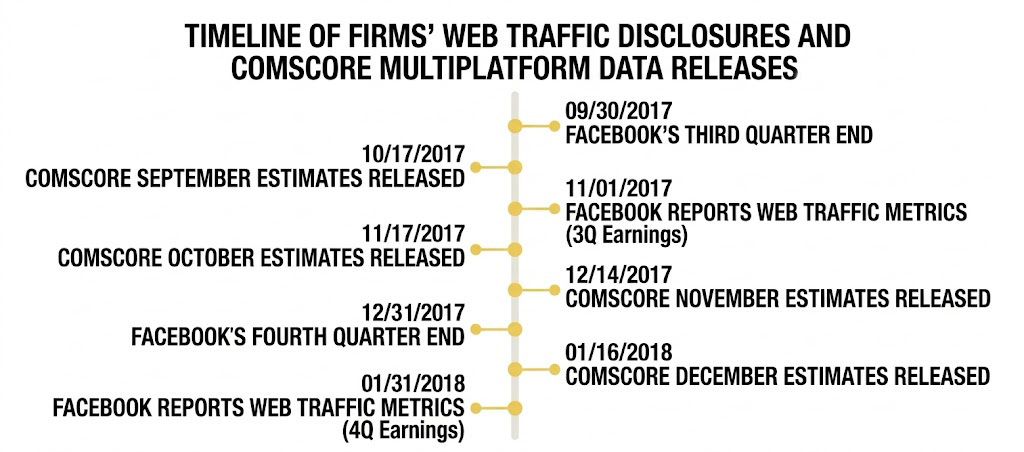
A timeline comparing third-party monthly data releases against quarterly company earnings announcements (using Facebook as an example). While external vendors provide more frequent updates, internal company disclosures deliver exact, comprehensive engagement numbers alongside quarterly financial results.
Source: Chen, P.-C., Sougiannis, T., Wang, Z. Z., & Wieland, M. (2026). The incremental informativeness of firm-disclosed web traffic metrics beyond third-party estimates. Journal of Accounting and Public Policy, 58, Article 107450.
The Predictive Horizon: Two to Four Quarters Ahead
To test which traffic numbers offer genuine financial foresight, the researchers analyzed 69 public internet companies, comparing 21 firms that voluntarily disclosed their internal user traffic metrics (such as monthly active users) against 48 firms that relied strictly on external third-party tracking.
The researchers found that first-party web traffic growth strongly predicts actual sales growth two, three, and four quarters into the future. In contrast, third-party vendor growth estimates held no statistically significant predictive power for future sales growth once other financial factors were accounted for.
The researchers suggest that this lag reflects the time required to convert increased user activity into monetized sales, subscriptions or advertising revenue. Early surges in user visits reflect growing brand awareness and consideration, but converting that top-of-funnel attention into monetized sales, subscriptions, or advertising revenue takes between 6 to 12 months to materialize on financial reports.
The study also found that analysts and investors respond to these disclosures in several ways:
- Equity analysts actively integrate firm-reported user traffic growth into their formal next-quarter revenue forecasts.
- Stock markets respond immediately with positive abnormal returns when companies release strong user growth numbers alongside quarterly earnings.
- Share prices experience a mild reversal 31 to 60 days later, suggesting investors initially overreact to short-term user growth milestones.
Debunking the Manipulation Myth
Because voluntary disclosures are published at management’s discretion, regulators like the U.S. Securities and Exchange Commission (SEC) have occasionally expressed concern that companies might strategically inflate user metrics to mask poor financial performance.
The researchers found no evidence to support these concerns. The researchers conducted extensive integrity checks and found no evidence of opportunistic reporting:
- Companies disclosing user metrics do not engage in higher earnings management or accounting manipulation.
- Disclosing firms are no more likely to receive SEC regulatory comment letters than non-disclosing peers.
- Disclosing firms do not inflate their reported user growth figures in quarters where they miss analyst profit or sales targets.
Instead, companies that choose to disclose user metrics tend to operate social platforms, digital marketplaces, and online communities, where active user participation directly drives the platform’s underlying economic value.
Implications for Financial Analysis
For investors and financial analysts, company-reported user metrics can provide an additional indicator of future revenue growth. Because changes in online customer activity may precede changes in reported sales, these metrics can provide information that complements traditional financial measures.
Why study this topic?
“I enjoy looking at information that investors can use to evaluate firms when traditional financial statements do not fully capture the key drivers of the business. What made this setting especially interesting to me was the availability of two different sources of information about essentially the same underlying activity—metrics voluntarily disclosed by firms and estimates produced by third-party vendors.”
MATThew Wieland


“As someone interested in firms’ financial reporting choices and quality, I was drawn to the research idea because we observed that some, but not all, internet firms chose to voluntarily report web traffic (a nonfinancial performance indicator) in their earnings releases. In addition to this unique reporting practice, third-party vendors also regularly provide estimates of similar information. The availability of two information sources (as Matt mentioned) makes it particularly interesting to me to investigate whether and how firm disclosures (arguably more accurate and complete, but subject to greater strategic reporting biases than vendor estimates) provide additional informational value to investors and analysts.”
Po-Chang Chen