
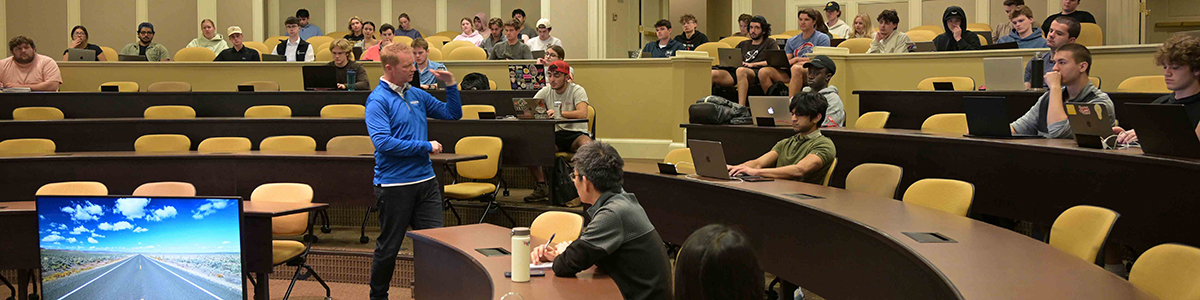
Students in ACC 321, Intermediate Financial Accounting, learned from guest speaker Daniel Perschke (’01, ’02 MAcc), senior vice president and controller of The E. W. Scripps Company, one of the largest broadcast companies in the US.
The company was founded by Edward Willis Scripps in 1878, starting as a newspaper company based in Cleveland, Ohio. Traditionally, news was only available to the wealthy, but Scripps built a business model that made news available to everyone and sold advertising to companies seeking to reach this audience. This goal demanded a clear line of separation between the business side and the information presented in the news, which Perschke says is still the case today. The company no longer owns newspapers but has television and cable networks.
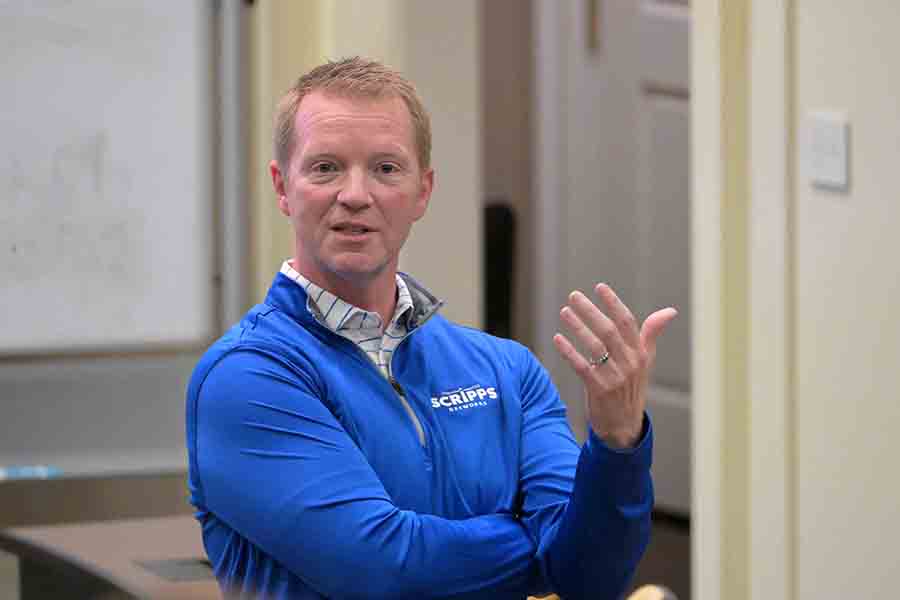
Perschke described the evolving media landscape and how businesses must continually adapt to shifts in both consumer preferences and habits—while adhering to government regulations, which cap broadcast station ownership. In a reflection paper, a student wrote, “It’s interesting to think about how regulations limit how much of the broadcasting market a company can own, and how that still shapes their strategy today. It made me appreciate how companies have to constantly find new ways to grow and stay relevant without losing sight of their original values.”
Accounting information is vital to this process, according to Perschke. In building his accounting team, he needed to clarify the vision of the accounting function and the value of accounting information. In doing so, he established three pillars:
- Delivering reliable information—this is the central pillar; the information must be trustworthy.
- Developing diverse talent through experience, education, and exposure—this includes helping non-accountants, such as marketers, understand the financial information within their own contexts.
- Enhancing business decisions with insight and support—one example that resonated with students was how financial information helped the company through COVID: by shifting their accounts receivable collections and mobilizing their sales teams to focus on companies that were still generating revenue through this difficult period.
“What value can we provide that is more than just doing the numbers?”
—Daniel Perschke
Perschke stated that accounting is not just spreadsheets, sitting in a cubicle, and financial statements—a truth that students came to appreciate as he continued describing his career leading to E.W. Scripps. “His vision helped me to see the profession as more dynamic and intellectually engaging than I previously thought,” wrote a student.
“Daniel explained how the accounting function at E.W. Scripps isn’t just about delivering reliable financial information but also about helping other departments understand and use financial data to make smarter decisions.”
The class appreciated Perschke’s career advice, as well as his description of his career path: “the best careers look like curvy roads.” As one student reflected, “It’s not only a linear path of ‘get your CPA, work at a public accounting firm, and eventually settle into a stable private accounting job’—while that path still fits with what I want, it is a field with more variety and opportunity than expected.” Students also mentioned the following important points:
- the importance of curiosity, communication, and critical thinking;
- accountants as storytellers, distilling complex financial data into meaningful insights that support decision-making;
- an emphasis on personal growth and being well-rounded, being curious in both accounting and life.
“His talk helped me view accounting as a career where curiosity and adaptability are just as important as technical skills, which made me even more excited about my future in the field.”


